
Every year the AOPA Air Safety Institute sorts the NTSB's general aviation accident records into the Richard G. McSpadden Report, formerly the Nall Report. The 36th edition, covering calendar 2024, is out. It counts 1,064 general aviation accidents in the United States, 164 of them fatal. Per 100,000 flight hours that is 3.69 accidents and 0.57 fatal accidents, down from 3.86 and 0.65 in 2023.
The report has a section on fixed-wing amateur-built airplanes, labeled "Sport/Experimental." It's the part of the report that speaks most directly to people who build and fly their own.
Amateur-built airplanes in 2024
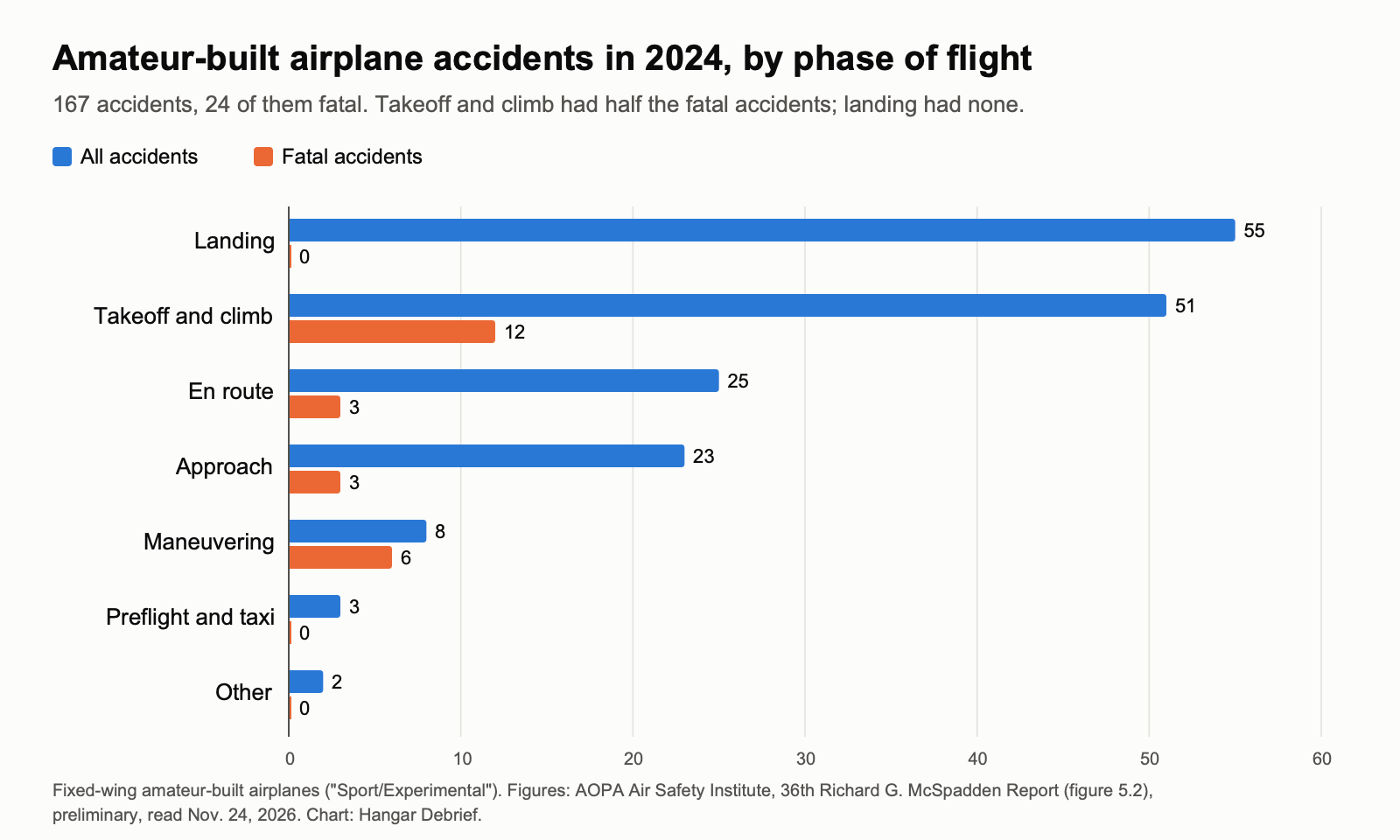
The report counts 167 accidents in amateur-built airplanes in 2024, 24 of them fatal. That is more accidents than in 2023 (158) and fewer fatal ones (29). In 2021 and 2022 the counts were 134 and 145 accidents, with 30 and 31 fatal.
Where in the flight they happened:
- Landing: 55 accidents, none fatal.
- Takeoff and climb: 51 accidents, 12 fatal.
- En route: 25 accidents, 3 fatal.
- Approach: 23 accidents, 3 fatal.
- Maneuvering: 8 accidents, 6 fatal.
- Preflight and taxi: 3 accidents, none fatal.
- Other: 2 accidents, none fatal.
Landings caused a third of the accidents and killed no one. Takeoff and climb caused almost as many accidents, and half of the fatal ones, with 17 people killed. Maneuvering flight caused only eight accidents, but six of those were fatal.
By kind of airplane, single-engine fixed-gear types had 143 of the 167 accidents and 17 of the fatal ones. Tailwheel airplanes alone had 79 accidents, nearly half the total, but only six were fatal. Single-engine retractables had 19 accidents, four fatal, and multiengine amateur-builts five accidents, three fatal.
The report also gives this group an accident rate, but it divides by 21.8 million hours, the flying of all non-commercial airplanes in 2024, not of amateur-builts alone. That figure says nothing about how often amateur-builts crash per hour flown, so Hangar Debrief doesn't quote it. The report doesn't say whether experimental light-sport airplanes are counted in the group.
All non-commercial airplanes
For the personal, business and instructional flying that most owners do, the report counts 902 accidents, 139 of them fatal, with 235 people killed. The report says both counts are the lowest of the past ten years. Pilot actions or decisions were tied to 642 accidents and 98 fatal ones. Mechanical causes were tied to 185 accidents and 21 fatal ones.
The pattern across all these airplanes matches the amateur-built figures. Landings caused 332 accidents and five fatal ones. Takeoff and climb caused 202 accidents and 36 fatal ones, the report says, with loss of control on the ground, engine failures and loss of control in flight the main types. Maneuvering caused 55 accidents, nearly half of them fatal. Weather caused only 23 accidents, but 14 were fatal, mostly VFR flight into instrument conditions. Fuel management caused 106 accidents, 10 of them fatal; fuel starvation was the largest share.
A partial loss of power
The mechanical figures tell owners what tends to go wrong. A total loss of engine power caused 42 accidents, four of them fatal. A partial loss caused 35 accidents, six of them fatal. Failures of other systems and components caused 31 accidents and no deaths. Failures in the engine's own systems caused 28 accidents and two deaths. Gear collapses caused 18 accidents and no deaths. Flight control failures caused nine accidents, three of them fatal, and fire or smoke caused eight, two of them fatal.
The institute made the same point about partial power loss in last year's report. Robert Geske, its director of aviation safety intelligence and analytics, said this year that "partial engine power loss had more lethal accidents than total engine failure, which suggests that pilots continue to struggle to adapt to a partial power failure." An engine that is still running but not making full power leaves the pilot with a choice a dead engine doesn't: keep flying to a runway or land now.
What to know about the numbers
The NTSB takes about two years to issue a probable cause, so the institute says only preliminary data exist for the most recent years. Its figures are refreshed every 30 days, and some 2024 accidents may move between categories as the NTSB finishes its reports. The figures here were read from the report's own pages and data on Nov. 20, 2026.
Sources: All read Nov. 20, 2026. AOPA Air Safety Institute, Richard G. McSpadden Report; 36th Richard G. McSpadden Report, 2024 figures and summary (figures 5.1 to 5.3 for amateur-built airplanes, 1.8.2 for mechanical accidents; the figure 5.2 phase-of-flight counts read again from the report's data on Nov. 24, 2026, unchanged); General Aviation News, Nov. 20, 2026 (the pointer, and Robert Geske's words).
Chart: drawn by Hangar Debrief from the figure 5.2 counts in the 36th Richard G. McSpadden Report, AOPA Air Safety Institute.