
An owner who spent the money on ADS-B Out before 2020 may be asked to spend again. On November 17, 2026, Senate Commerce Committee Chairman Ted Cruz announced that the Senate and House have reached "an agreement in principle to mandate ADS-B In." In his words: "all aircraft required to broadcast their location via ADS-B Out will now be mandated to receive those same signals through ADS-B In."
It isn't law. The four committee leaders, Cruz, Ranking Member Maria Cantwell, House Transportation and Infrastructure Chairman Sam Graves and Ranking Member Rick Larsen, agreed on the civil aviation parts of a bill. The Armed Services committees of both houses have not signed on to the parts about military aircraft, and the committee's announcement says lawmakers are "wrapping up a final deal on the full text." That text hasn't been published. Cruz said he wants it passed before the 119th Congress ends.
Where the deal comes from
The agreement settles the differences between two bills written after the January 2025 midair collision of American Airlines Flight 5342 and an Army UH-60 near Ronald Reagan Washington National Airport, which killed 67 people. The Senate passed S. 2503, the ROTOR Act; the House passed H.R. 7613, the ALERT Act of 2026. Which of their words survive into the final bill isn't known, but on the parts that touch a light airplane the two said much the same thing.
Who would be covered. Both bills reach the aircraft required to carry ADS-B Out by 14 CFR 91.225. That rule asks for ADS-B Out in Class A, B and C airspace, within 30 nautical miles of the airports listed in appendix D of part 91 up to 10,000 feet MSL, above the ceiling of Class B and C airspace up to 10,000 feet, and in Class E airspace over the 48 contiguous states at and above 10,000 feet MSL (but not within 2,500 feet of the surface). An aircraft never certificated with an engine-driven electrical system, such as a glider or a balloon, is excepted in parts of that airspace by 91.225(e).
The deadline. Both bills gave the FAA two years from enactment to issue a final rule, and both set December 31, 2031, as the date to be equipped. The Senate bill also let an owner apply for up to one more year.
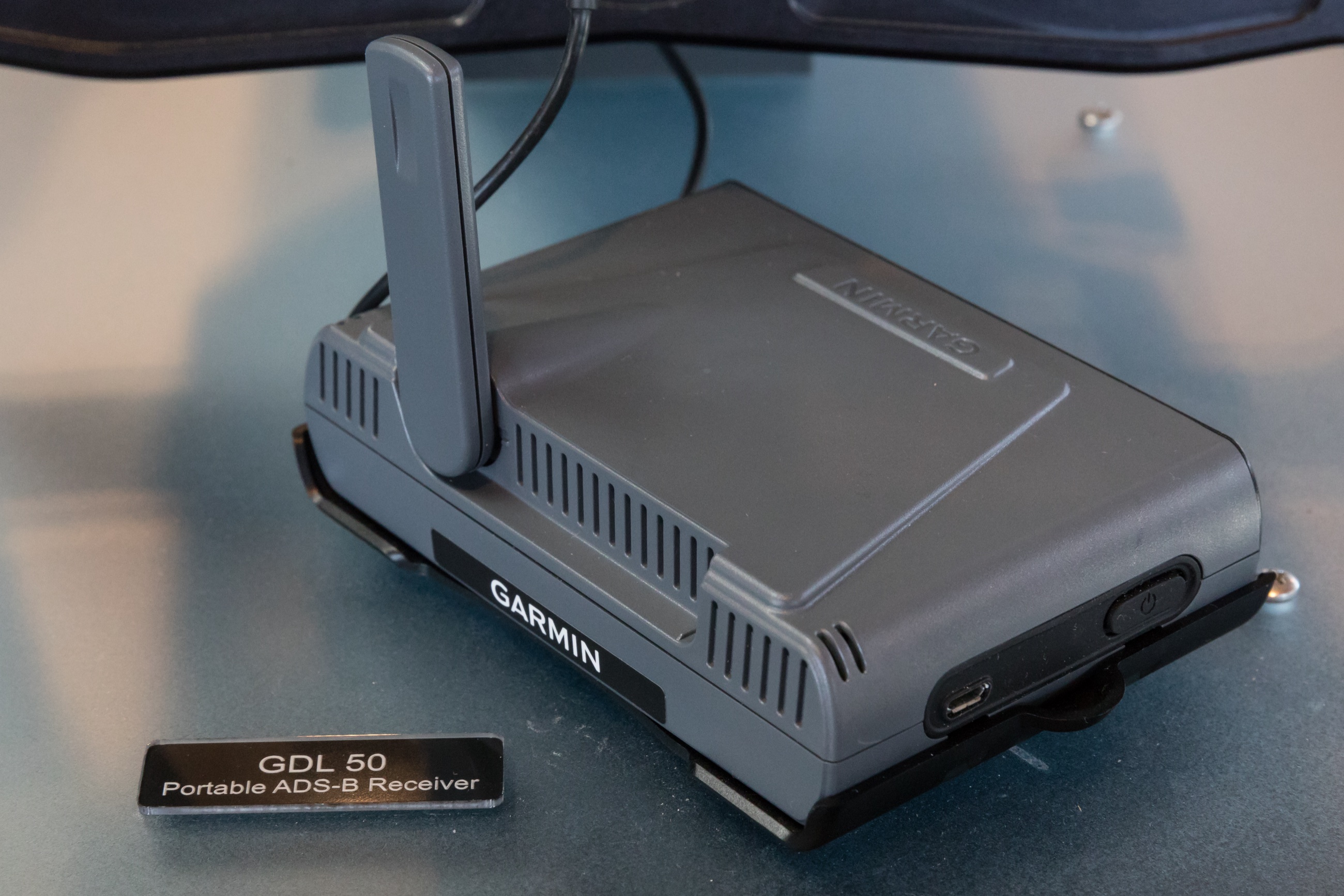
What would count. The Senate bill wanted traffic awareness with "visual and aural advisories," in the air and on the airport surface. For aircraft under 12,500 pounds maximum takeoff weight flown under part 91, it told the FAA to set performance requirements for low-cost alternatives and to consider "portable ADS-B In receivers" and equipment that displays on "an existing or future electronic flight bag or panel mounted display," as long as it doesn't adversely affect other required avionics or the airworthiness of the airplane. The House bill called the equipment "collision prevention technology," also required visual and audible alerting, asked the FAA to consider how a device is mounted so it has "minimal risk of unexpected detachment" and how it behaves when GPS is jammed or spoofed, and allowed portable receivers on a tablet, EFB or panel display if the FAA finds them an equivalent level of safety.
Experimental airplanes. Only the House bill had an exception for them. It left out aircraft with an experimental or limited category special airworthiness certificate, provided the pilot gets an ATC deviation in the same way an ADS-B Out deviation is approved under 91.225(g). The Senate bill had no such exception. Whether it is in the agreed text isn't known.
What an owner can do now
Nothing is required today, and no one yet knows what equipment the FAA will accept. Many airplanes already have ADS-B In through a dual-link receiver feeding an EFIS or a tablet, and a builder planning a panel can see which displays and receivers show traffic in Hangar Flying's Panel Designer. Whether a given setup would satisfy a future rule depends on the alerting and installation standards the FAA writes, and both bills asked for aural alerts, which not every tablet arrangement gives. An owner deciding on avionics this winter has reason to prefer equipment that shows traffic with an audible alert, but buying something for this rule alone would be guessing.
What is not known
- The final bill text, and whether Congress passes it before the session ends.
- Whether experimental amateur-built and light-sport airplanes get the House bill's exception.
- What the FAA will accept as ADS-B In for a light airplane, and whether a portable receiver will do.
- What it would cost an owner. The committee's announcement mentions no rebate or funding for owners.
Hangar Debrief will report the text when it is published.
Sources
- U.S. Senate Committee on Commerce, Science, and Transportation, Key Senate and House Leaders Agree on ADS-B Safety Legislation Framework, November 17, 2026. Read November 18, 2026.
- S. 2503, ROTOR Act, as passed by the Senate (engrossed), section 4, "ADS-B In requirements." GovInfo, read November 18, 2026.
- H.R. 7613, ALERT Act of 2026, as passed by the House (engrossed), section 104, "Collision prevention systems." GovInfo, read November 18, 2026.
- 14 CFR 91.225, Automatic Dependent Surveillance-Broadcast (ADS-B) Out equipment and use. eCFR, read November 18, 2026.
- AVweb, Lawmakers Reach Deal on ADS-B In Mandate, November 18, 2026, the pointer to the announcement.
- Photo: AERO Friedrichshafen 2018, Friedrichshafen (1X7A4803).jpg) by Matti Blume, Wikimedia Commons, CC BY-SA 4.0.