At a towered airport with a line of airplanes waiting to go, a pilot calling ready at the hold-short line often hears "Runway 24L, line up and wait." It lets the airplane taxi onto the runway and sit there, lined up, while the tower waits for a landing airplane to clear or a departure ahead to get far enough away. Since Tuesday, November 24, 2026, a tower may give that instruction only while one more person is on duty in the cab, doing nothing else.
The change is FAA Notice N JO 7210.979, "Line Up and Wait (LUAW) Operations Watch Supervision Requirement," signed October 8 and effective November 24, 2026. It is an air traffic order, written for controllers and their managers, not a rule for pilots. But it decides whether a pilot hears those words at all.
What the notice changes
Line up and wait, LUAW in the FAA's documents, is governed for tower managers by paragraph 10-3-8 of FAA Order JO 7210.3, Facility Operation and Administration. Until Monday the paragraph said that the operations supervisor or controller-in-charge position "should not be combined with any other position." The notice replaces that line with this one:
A stand-alone watch supervision (OS/CIC) position must be staffed and must not be combined with any other position.
The notice gives its reason in one paragraph. Changing "should" (a recommendation) to "must" (a mandatory requirement), it says, "ensures that the personnel providing watch supervision (OS/CIC) are fully dedicated to overseeing the safety of the operation without the distraction of simultaneously managing other operational tasks." It doesn't point to an incident or say how many towers had been combining the positions.
The notice also rewords the paragraph before it, which already kept the local controller, the one talking to airplanes on the runway, from also working ground control, clearance delivery, flight data or the supervisor's position while LUAW is in use. That part was a requirement before and still is.
The notice carries a cancellation date of June 9, 2027. It says nothing about what takes its place then.
What it means at the hold-short line
The notice doesn't change a word of what a pilot is told or must do. What changes is how often a tower can use the procedure. Read together, the two lines of paragraph 10-3-8 mean a tower needs at least three people working for LUAW: the local controller on tower frequency, someone on the other cab positions such as ground and clearance delivery, and a supervisor or controller-in-charge doing nothing but supervising. At a tower that can't put three people in the cab, on a late shift or a short-staffed day, controllers can't use line up and wait at all.
For a pilot that means holding short until the tower can say "cleared for takeoff," and then taxiing onto the runway and going without stopping. A departure may wait a little longer at a busy hour. The notice doesn't say how many towers will be affected or when, and Hangar Debrief found no FAA statement on it by Wednesday morning.
Some limits on LUAW were already in the controllers' handbook, FAA Order JO 7110.65, paragraph 3-9-4, and they stay: no LUAW when the departure point can't be seen from the tower, unless surface radar shows the airplane or the runway is used only for departures; no LUAW at an intersection at any time when the tower can't see that intersection; and only one airplane at a time lined up on the same runway in daylight unless a local assist or local monitor position is staffed. At night, LUAW at an intersection is allowed only on a departure-only runway, one airplane at a time, under a procedure the FAA's service area director has approved.
What a pilot does on hearing it
Paragraph 5-2-5 of the Aeronautical Information Manual is the pilot's side of the procedure, and none of it has changed:
- It is not a takeoff clearance. The AIM says plainly that "LUAW is not an authorization to takeoff," and notes that reviews of air traffic events found "a significant number of pilots read back LUAW instructions correctly and departed without a takeoff clearance."
- Ask if it goes quiet. "If a takeoff clearance is not received within a reasonable amount of time after instructed to LUAW, ATC should be contacted."
- Listen to the others. The AIM asks pilots to monitor the instructions given to other airplanes, to listen for similar call signs, and to be especially alert at night, with intersecting runways in use, and in low visibility, scanning the full length of the runway before entering it.
- Know where the traffic is. When landing traffic is a factor, the tower tells the airplane in position about the closest traffic within six flying miles to the same runway. When cleared to line up at an intersection, the tower names it; if the intersection is left out, the AIM says to ask.
- Be seen. AIM 4-3-24 says that when entering the runway to line up and wait, all lights except the landing lights should be on, and the landing lights on when the takeoff clearance comes.
- Never land on an occupied runway. The same AIM paragraph tells a landing pilot never to land on a runway another airplane is on, even with a landing clearance, and to be ready to go around.
What is not known
- Which towers will stop using line up and wait, at what hours, and how often.
- Whether the FAA will make the requirement permanent in JO 7210.3 when the notice lapses on June 9, 2027.
- What led to the change. The notice names no event, and the FAA hasn't published one.
Sources
- FAA, Notice N JO 7210.979, Line Up and Wait (LUAW) Operations Watch Supervision Requirement, effective November 24, 2026, cancellation date June 9, 2027. Read November 25, 2026.
- FAA, Order JO 7210.3, Facility Operation and Administration, chapter 10, section 3, paragraph 10-3-8, as published before the notice. Read November 25, 2026.
- FAA, Order JO 7110.65, Air Traffic Control, chapter 3, section 9, paragraph 3-9-4, Line Up and Wait (LUAW). Read November 25, 2026.
- FAA, Aeronautical Information Manual, chapter 5, section 2, paragraph 5-2-5, and chapter 4, section 3, paragraph 4-3-24. Read November 25, 2026.
- AVweb, FAA Tightens Line Up And Wait Requirements, November 24, 2026, which first reported the notice in effect.
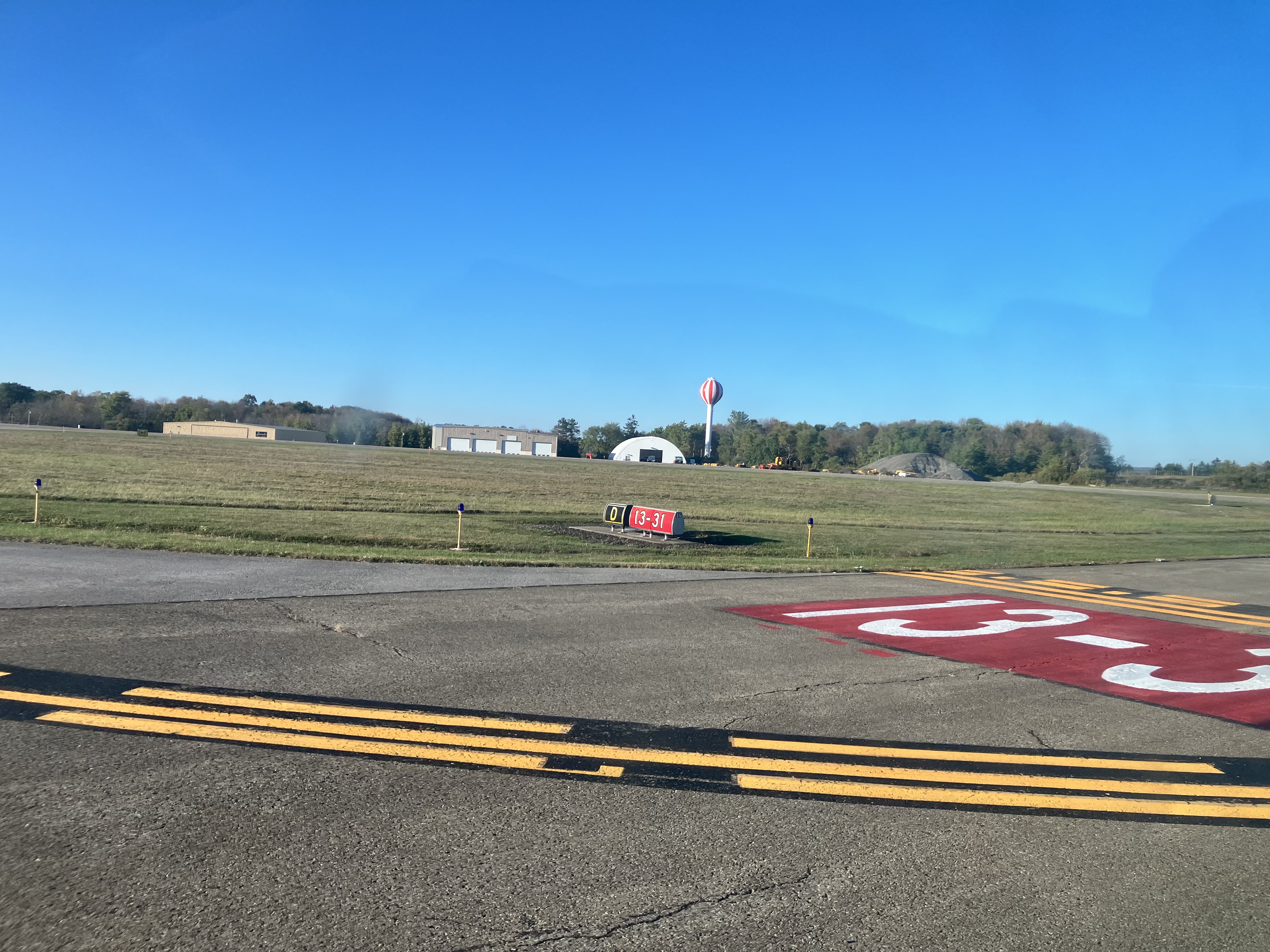
- Photo: Hold short line of Runway 13-31 at Jamestown Chautauqua County Airport by Designism, Wikimedia Commons, CC0.