
The iPad mini has been the general aviation tablet for a decade. It fits a kneeboard, mounts on a yoke without blocking the panel, and runs ForeFlight, Garmin Pilot and every other EFB worth having. It was never a great cockpit display, and pilots' complaints have been the same for years: hard to read in the sun, a glossy screen that reflected the sky and the pilot's shirt, and redraws that lagged once synthetic vision and a few weather layers were on.
Apple announced a new iPad mini on Oct. 26, 2026, with the A20 Pro chip, and it reaches customers Friday, Nov. 6. On paper, it addresses most of that list.
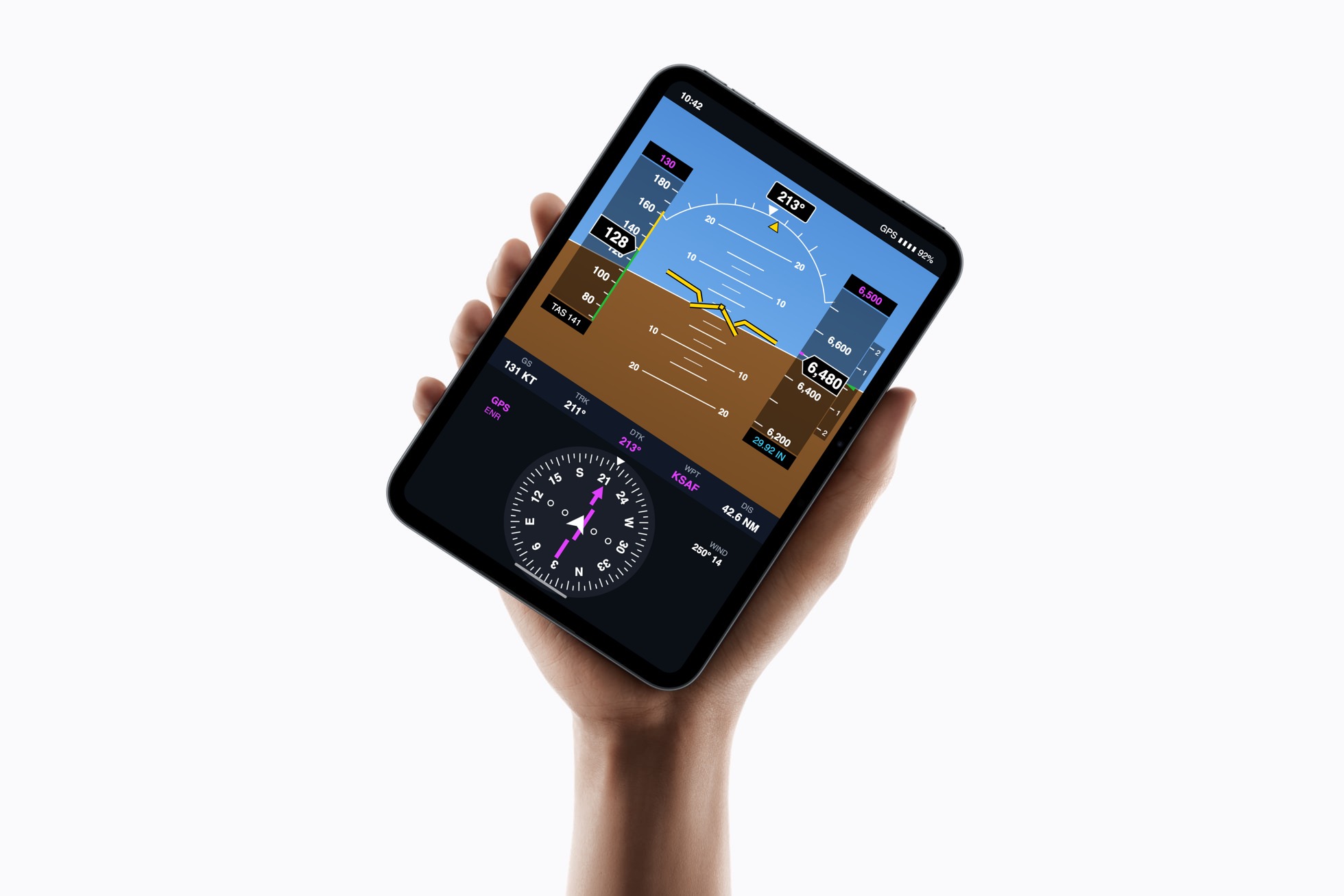
The screen
The new mini has an 8.5-inch OLED display, up from 8.3 inches. Apple's spec sheet gives it 600 nits for standard content and 1,200 nits peak. The 1,200 figure is for HDR content only. A sectional, an approach plate and a moving map are standard content, so the number that matters in the cockpit is 600, against 500 on the last two minis. That is a 20 percent gain on a sunny day, not double.
OLED helps in another way. Each pixel makes its own light, so a black area is black, not a gray backlight, and Apple rates the contrast at 2,000,000:1. A dark-mode chart or a night-mode map should read cleaner against a bright window. At the other end, Apple says the screen dims to 1 nit, which matters to anybody who has flown at night with a tablet that wouldn't go dark enough.
Nano-texture glass
For the first time, the iPad mini can be ordered with nano-texture glass, the etched, matte finish Apple has offered on the iPad Pro. Apple pitches it for "technicians working in the field." Under a bubble canopy, or in a high-wing with the sun behind the pilot, glare is often a bigger problem than brightness. A matte screen scatters the reflection instead of showing it. MacRumors reports it adds $100 and is offered only on the 256 GB and 512 GB models.
A matte finish trades a little crispness for less reflection. It is worth seeing one in a store before paying for it.
The A20 Pro chip
The A20 Pro replaces the A17 Pro. MacRumors puts Apple's figures at up to 60 percent faster for the processor and 2.7 times for graphics. EFB apps lean on the graphics side: 3D synthetic vision, terrain shading, radar loops, and panning a chart at full zoom. The old mini handled all of that, but it could stutter with several layers on. Apple's new chip is built on a 2-nanometer process, its smallest yet.
Problems with the older minis
- Dim screens. The iPad mini 6 and the A17 Pro mini both topped out at 500 nits, an LCD with a backlight.
- Jelly scrolling. When the mini 6 shipped in 2021, owners reported text that seemed to tilt and wobble when scrolling in portrait, MacRumors and What Hi-Fi reported at the time. Since it showed in portrait and not in landscape, it was put down to the way the LCD refreshed. The new mini uses a different kind of panel. Whether that fixes it will be clear once owners have them.
- Heat. Pilot forums are full of minis that shut down in a hot cockpit, usually on a glareshield or in a yoke mount in direct sun. The reports are mixed, and many pilots never see it, but every one names the same cures: shade, airflow, a vented mount.
- No GPS on the cheaper model. It is still true. Only the Wi-Fi + Cellular model has GPS and GNSS. iPad Pilot News notes the receiver works without a data plan.
What hasn't changed
The temperature limit. Apple's spec sheet still lists an operating range of 32° to 95°F. A cockpit on a summer ramp passes 95 in minutes, and a tablet in the sun runs hotter than the air around it. The limit is the same, so the old habits stay: keep it out of direct sun, give it airflow, and carry a backup.
Battery life. Apple still rates the mini at up to 10 hours on Wi-Fi and 9 hours on cellular data, the same as before. A moving map with the screen turned up uses it faster than a web page does. Apple says a 35-watt or larger charger fills it to 50 percent in about 30 minutes.
Other changes
- IP67. It is rated against dust and water to 1 meter for 30 minutes. That covers rain on the ramp and a water bottle in the flight bag. Apple says the resistance isn't permanent and liquid damage isn't covered by the warranty.
- Size and weight. It is 7.69 by 5.22 inches, about the same as the last mini, but 5.4 mm thick instead of 6.3. The Wi-Fi model weighs 0.56 lb and the cellular one 0.58 lb. A mount that clamps on the tablet should still fit. A mount that holds a case needs a case made for the new model.
- Price. It starts at $699 for Wi-Fi and $849 for Wi-Fi + Cellular, the model with GPS.
ForeFlight and Garmin Pilot
Neither ForeFlight nor Garmin has said anything about the new mini yet. Both apps currently need iPadOS 18 or later, and the new mini ships with iPadOS 27, so both should install. A pilot should check the app's supported device list and try the setup on the ground before flying behind one.
The FAA's guidance
For a Part 91 pilot, nothing about this iPad changes the rules. The FAA's advisory circular on EFBs, AC 91-78A, says an EFB can be used in place of paper in all phases of flight, with no formal approval, when the information is current and valid, as verified by the pilot, and it doesn't replace equipment Part 91 requires. It asks the operator to think through "display and lighting issues, system shutdown, and system failures," and where the device is stowed for takeoff and landing. A brighter, matte screen helps with the first of those. The last two are still the pilot's to plan for.
Sources: Apple, "Apple gives iPad mini its biggest update ever," Oct. 26, 2026; Apple, iPad mini technical specifications; MacRumors, Oct. 26, 2026; MacRumors, "iPad Mini 6 Users Complain of 'Jelly Scrolling' Issue," Sept. 27, 2021; What Hi-Fi?, on jelly scrolling; iPad Pilot News, "What's the best iPad for pilots, 2026 edition"; Swappa, "Best used iPad for pilots"; pilot reports on Pilots of America and EuroGA; FAA, AC 91-78A, Use of Electronic Flight Bags, Feb. 23, 2024. All read Nov. 3, 2026.
Photo: Apple, from its announcement, Oct. 26, 2026. The flight display on its screen was drawn by Hangar Debrief.