
A pilot with a logbook full of piston time doesn't usually think of it as a line on an astronaut application. NASA's new call for astronaut candidates says it can be one. The agency opened applications on Nov. 7 and is taking them until 11:59 p.m. Eastern on Thursday, Dec. 3, through its announcement on USAJOBS.
The flight hours count toward one requirement, though, not all of them. They take the place of three years of professional experience. They don't take the place of the degree.
What the hours have to be
NASA's release lists three ways a pilot can meet the experience requirement:
- High-performance jets: 750 hours as pilot in command.
- Other fixed-wing aircraft: 1,500 total hours, 750 of them as pilot in command.
- Rotary-wing aircraft: 1,000 total hours, 300 of them as pilot in command.
An applicant needs only one of the three. The USAJOBS announcement adds two limits that matter to a general aviation pilot adding up a logbook: initial flight training hours aren't counted, and neither is time spent controlling an unmanned aircraft. Anyone claiming flight experience sends in NASA's pilot qualifications form with the application.
NASA's frequently asked questions are plain that civilian time is welcome. Jet experience usually comes from the military, the page says, but "any type of flying experience-military or private, is beneficial to have." It also says flying isn't required at all: three years of work in the applicant's field meets the same requirement.
What the hours don't cover
Every applicant has to be a U.S. citizen and hold a master's degree in a science, technology, engineering or mathematics field from an accredited school. NASA accepts three things in place of the master's: two years of work toward a doctorate in one of those fields; a medical degree such as an M.D. or D.O.; or a nationally recognized test pilot school, finished by July 2027, along with a bachelor's degree in one of those fields if the school is the applicant's only advanced training.
Then there is the physical. Candidates have to pass NASA's long-duration astronaut flight physical, and the FAQ says NASA grants no waivers of its medical requirements. Vision has to be correctable to 20/20 in each eye, near and far; glasses and PRK or LASIK surgery are allowed. There's no age limit. NASA says past candidates have been 26 to 46 years old when selected, 34 on average.
The odds, and the job
NASA last took applications in 2024. More than 8,000 people applied, and 10 were selected in 2025. They're still in training. The agency says it has selected 370 people as astronaut candidates since the 1960s and has 32 active astronauts today.
Those chosen this time become astronaut candidates, not astronauts. The USAJOBS announcement, which gives the job's location as Houston, describes about two years of training and evaluation and says selection as a candidate doesn't guarantee selection as an astronaut. The pay it lists is $164,395 a year on the 2026 schedule. NASA says the training covers spacewalking, lunar geology and flying high-performance aircraft, among other things.
The agency ties the class to its Moon program. The release speaks of missions near the lunar South Pole, a base on the Moon and groundwork for the first crewed missions to Mars. "The people we select could walk on the Moon, live and work at the Moon Base, and help pioneer the systems and operations that will ultimately carry crews to Mars," NASA Administrator Jared Isaacman said in the release.
What isn't known
NASA expects to make its final selection in late 2027. It hasn't said how many candidates it will take or when the class reports to Houston. The release doesn't say whether the requirements changed from the 2024 call, and Hangar Debrief didn't compare the two announcements. Anyone who applied before has to apply again; the announcement says earlier applications don't carry over.
Sources: NASA, "NASA Seeks Next Generation of Explorers to Join Astronaut Corps," release 26-093, Nov. 7, 2026; USAJOBS, Astronaut Candidate, announcement NASA-13093568-27-AS; NASA, "Becoming an Astronaut: Frequently Asked Questions"; NASA, "Become an Astronaut".
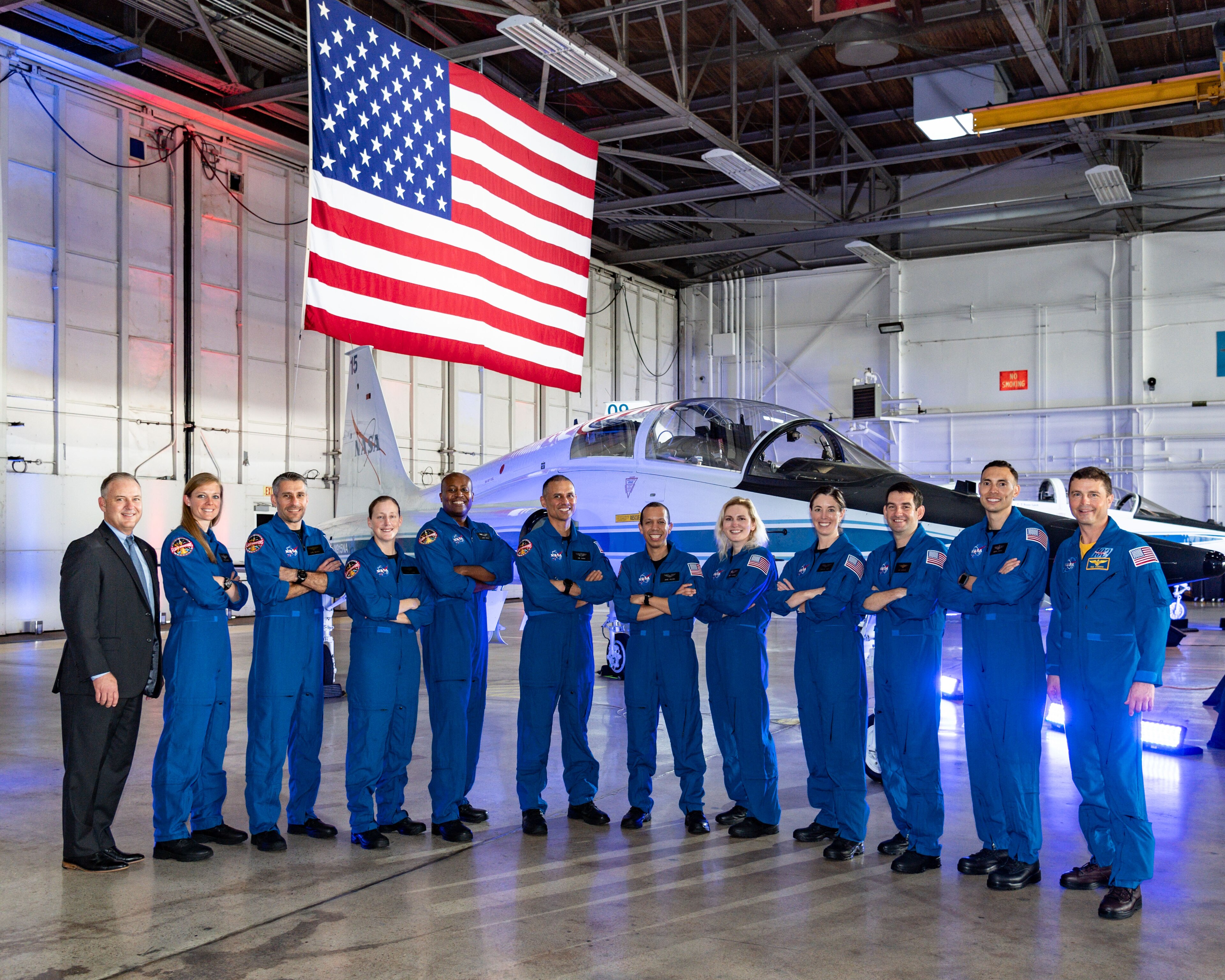
Photo: NASA 2021 Astronaut Candidate Announcement at Ellington Field by NASA/Robert Markowitz, public domain, via Wikimedia Commons.