
Tens of thousands of pilots who went on to fly in combat in the Second World War trained in the same airplane: a big, noisy two-seat trainer with a radial engine and a tailwheel. The Army called it the AT-6 Texan, the Navy the SNJ, and the Royal Air Force the Harvard. FLYING ran a piece on Oct. 26 under the airplane's nickname, the "Pilot Maker," and the history behind the name is worth telling on its own.
From a basic trainer to an advanced one
The airplane started as an entry in the Army's basic trainer competition of 1935. The Smithsonian's National Air and Space Museum credits the design to North American Aviation's J. H. "Dutch" Kindelberger, J. L. Atwood and H. R. Raynor. The Army ordered it into production as the BT-9, for Basic Trainer No. 9, followed by the BT-9A, B and C. In 1936 the Navy bought 40 under an Army contract as the NJ-1.
The early airplanes were simple. The Naval History and Heritage Command describes the earliest version as an open-cockpit monoplane with fixed gear and a fabric-covered fuselage. By the SNJ-1 of 1938 it had become an all-metal airplane with retractable gear, and in the war it became the advanced trainer for the Army, the Navy, the Royal Air Force and many other air forces. That's where the designations come from: AT-6 for Advanced Trainer No. 6, and in the Navy's SNJ, S for scout (meaning an advanced trainer), N for trainer and J for North American.
The Navy's own museum airplane, an SNJ-5C, lists one 550-horsepower Pratt & Whitney R-1340-AN-1, a 42-foot wingspan, 4,158 pounds empty and 5,300 pounds gross, and a top speed of 205 mph at 5,000 feet.
How many were built
Nobody has an exact number. The Smithsonian says not all the records survive and puts the count at "very close to 15,000," over a production run from 1935 into the 1950s, modifications included. The Navy's museum counts more than 17,000 delivered to the U.S. military and other nations and calls it the most widely used trainer ever. The Smithsonian lists more than 40 countries that bought it or built it under license, from Argentina to Zaire, and says no other trainer has been operated by so many.
What training in one looked like
During the war, the Smithsonian writes, tens of thousands of young men trained as Army pilots and Naval Aviators in the Texan before going on to operational units. The Navy also used it to teach carrier work: the SNJ-4C carried an arresting hook so students could qualify aboard ship. According to the Navy, an SNJ was used in 1953 to test day and night touch-and-go and arrested landings on the Navy's first angled-deck carrier, Antietam.
Retired, then called back
At the end of the war the services expected to replace it. Thousands went into storage or to the Reserves, and many were sold, which the Smithsonian says accounts for a good part of that list of countries. The replacement didn't arrive in time. When the Korean War brought a large increase in pilot training, the old basic trainers were gone, and the AT-6 and SNJ went back into service. For much of the 1950s the Naval Air Basic Training Command flew nothing but SNJs.
The Smithsonian's description of that syllabus would be familiar to any pilot. Primary training at Whiting Field covered takeoffs and landings, crosswind landings, emergency landings, stalls, spins and aerobatics. Formation followed at Saufley Field, then gunnery and carrier qualification from Barin Field, then instruments at Corry Field, with the student in the back seat under a canvas hood. A student finished basic training after about a year with a little over 200 hours, all of it in SNJs.
The airplane did more than train. The Navy's museum notes that Air Force versions flew combat missions as forward air controllers, and the Smithsonian that the type served as a "Target Director" in the Korean War. The Navy also notes that SNJs were dressed up as Japanese Zeros for the film Tora! Tora! Tora!
Still flying
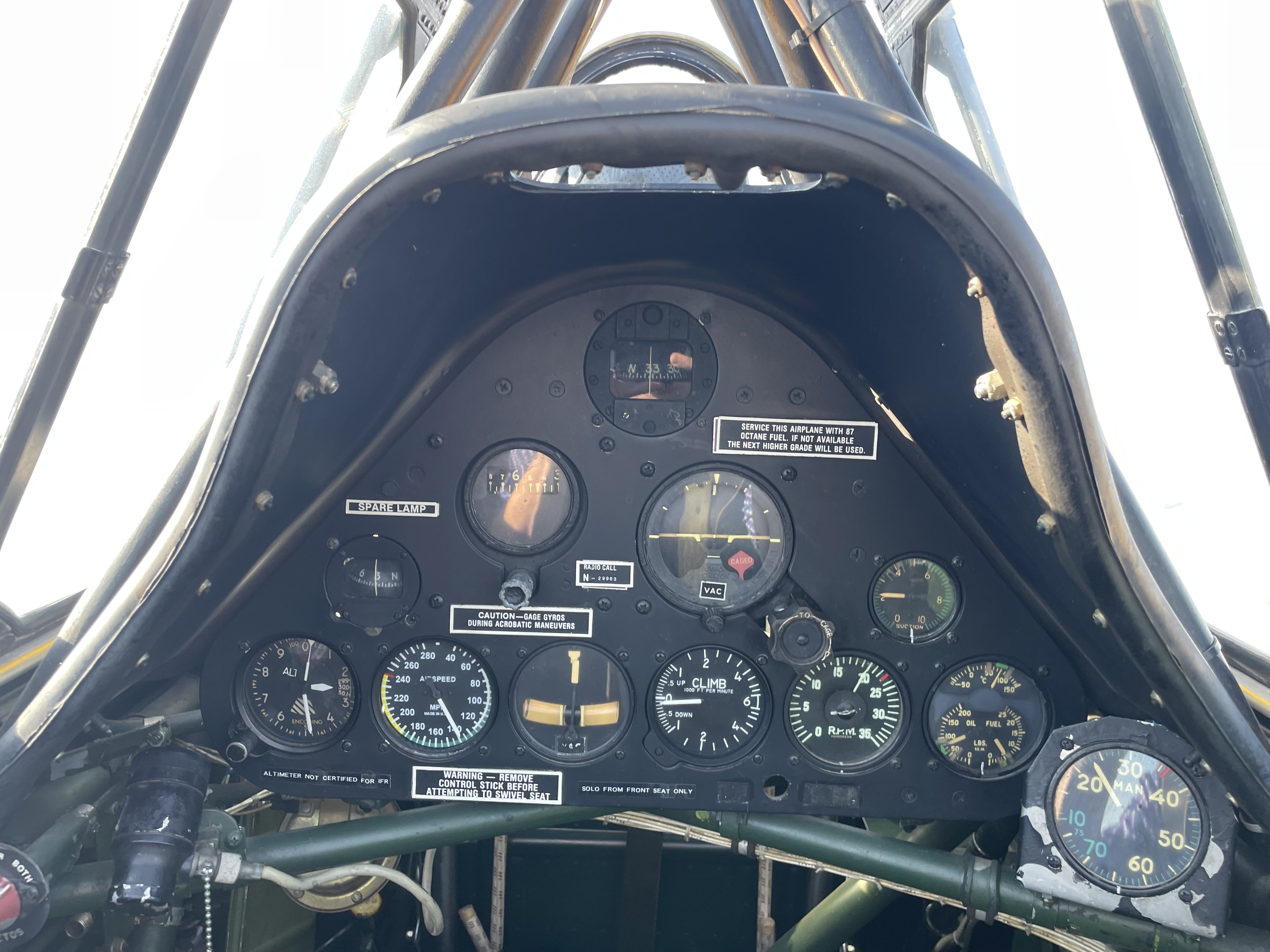
The Smithsonian's own SNJ-4, Bureau Number 51398, trained Naval Aviators from 1943 to 1945, went to the Reserves at NAS New Orleans, returned to Whiting Field in 1953 and was stricken in 1955. It joined the museum's collection in September 1960. Many others never stopped flying. As the museum puts it, aerobatic teams and individuals still fly the AT-6 and SNJ, an airplane designed in 1935. The cockpit in the picture above, photographed at a Louisiana airport last fall, still carries its placards from that life: service with 87 octane, cage the gyros during aerobatics, solo from the front seat only.
Sources: Smithsonian National Air and Space Museum, North American SNJ-4 (AT-6), object A19610123000; Naval History and Heritage Command, National Naval Aviation Museum, SNJ Texan; FLYING, Sean Siff, "Chasing History in the T-6 'Pilot Maker,'" Oct. 26, 2026 (the owner's pointer to the subject).
Photo: North American T-6 Texan interior 01 by Ktkvtsh, CC BY 4.0, via Wikimedia Commons.