
Most X-plane flying happens where few people see it. NASA's X-59 spent its first year over the Mojave, then on Oct. 28, the first anniversary of its first flight, it left California on its first long cross-country trip. AvBrief reports stops at El Paso, Fort Worth and Birmingham on the way to Kennedy Space Center.
It's an airplane built to answer one question, and the answer could change a rule. Under 14 CFR 91.817, nobody may operate a civil aircraft in the United States faster than Mach 1 without an authorization under 91.818. The X-59 exists to find out whether a supersonic airplane can be quiet enough that people on the ground don't mind.
What the first year showed
NASA test pilot Nils Larson made the first flight on Oct. 28, 2025, from Palmdale to Edwards, in 67 minutes at about 230 mph with the gear down, climbing to about 12,000 feet. NASA's one-year summary counts 40 more flights since then, up to more than 56,000 feet and Mach 1.53. The design cruise is Mach 1.4, or 924 mph, at 55,000 feet.
The envelope opened in steps. The airplane first went supersonic, at Mach 1.1, on June 5 and reached its cruise point a week later. By its 25th flight, NASA said flying qualities, stability margin and flight loads closely matched the simulations, with no unexpected instability or excessive vibration. The fixes so far were small: minor control software adjustments, and clearing nuisance alerts that were being treated as caution warnings. NASA kept testing the low and slow end of the envelope as well as the fast end.
In September it flew six flights in one week, a record for the airplane, and then stopped for about three weeks of scheduled maintenance and a systems review. NASA test pilot Mike Lippert made his first flight in it on Oct. 21, about an hour at Mach 1.4 and 55,000 feet, after months in the simulator.
An airplane with no forward window
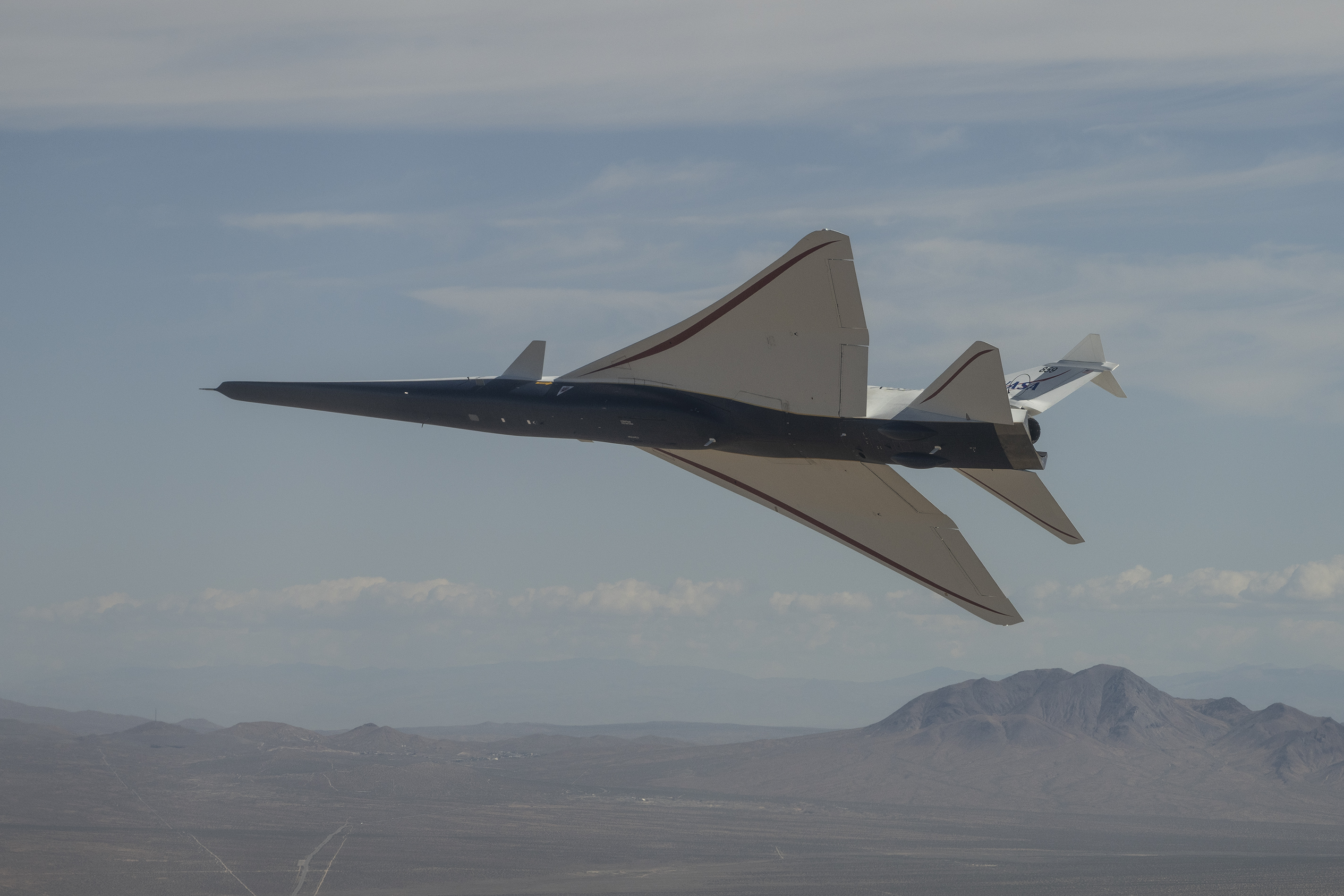
The X-59 is about 99.7 feet long and 29.5 feet wide, and the shape is the experiment. The long nose and the rest of the outer lines spread out the shock waves so they don't merge into a boom on the ground. The single GE F414 engine sits on top of the fuselage, which sends its noise upward.
That nose blocks the view ahead, so the cockpit sits mid-fuselage with no forward-facing window. NASA's eXternal Vision System puts cameras and sensors outside and high-definition displays inside, and NASA says it matters most on landing. Pilots with synthetic vision on a panel know the idea, but the X-59 relies on its picture to see the runway.
What comes next
The next phase is acoustic validation: recording and studying what the airplane sounds like on the ground and in the air. NASA's target is a thump it compares to a car door closing about 20 feet away. Nobody has heard that on the test flights yet: NASA says a chase airplane has flown on all of them, and its own booms masked any noise from the X-59.
After that, NASA plans to fly the airplane over communities, survey how people respond and give the results to U.S. and international regulators, who could use them to set a noise threshold for supersonic flight over land. NASA's mission page gives the mission's duration as through 2029. A May update said NASA aimed to finish the first two phases by the end of 2026. The Oct. 28 post says only that envelope work continues "in the coming months."
What isn't known about Florida
FLYING reports NASA Administrator Jared Isaacman confirmed on X that the airplane was going to Kennedy Space Center. MAX POWER, a ticketed aerospace festival there, runs Nov. 7 and 8, and its schedule lists a talk on the X-59 by NASA's Peter Coen and Lockheed Martin's Ron Fehlen at 11:15 a.m. on Nov. 7. NASA's event page doesn't say whether the airplane itself will be on display or will fly, and Hangar Debrief found no NASA statement that settles it.
Sources: NASA, "NASA Celebrates a Year of Progress Since First X-59 Flight," Oct. 28, 2026; NASA, "NASA's X-59 Aircraft Builds Momentum Through 25th Flight," Sept. 4, 2026; NASA, record week, Oct. 2, 2026; NASA, Mike Lippert's first flight, Oct. 22, 2026; NASA, first flight; NASA, how the X-59 is designed; NASA, Quesst mission; NASA, MAX POWER; 14 CFR 91.817; AvBrief, "X-59 Heads to Florida From Edwards," Oct. 29, 2026; FLYING, Oct. 30, 2026.
Photo: NASA's X-59 Soars Above Armstrong Flight Research Center.jpg) by NASA/Jim Ross, public domain, via Wikimedia Commons.