
The owner of a Cessna 172 or a Piper Cherokee who wants to change a tire, clean the spark plugs or put in a new battery does not need a mechanic for it. The FAA calls that kind of work preventive maintenance, and it lets a pilot do it on the pilot's own airplane and sign for it. The catch is that the list is closed. A job that is on it is the owner's to do; a job that is not on it belongs to a mechanic, however simple it looks.
Who may do it
14 CFR 43.3(g) gives the privilege to "the holder of a pilot certificate issued under part 61," on "any aircraft owned or operated by that pilot" that is not used under part 121, 129 or 135. The words "or operated" mean the rule is not limited to the registered owner.
A sport pilot certificate is narrower. Its holder may do preventive maintenance only on an aircraft the pilot owns or operates that has "a special airworthiness certificate in the light-sport category." Sport pilots may now fly many type-certificated airplanes, but the eCFR text read for this article still gives a person who holds only a sport pilot certificate no preventive maintenance on one. A pilot with a private certificate or higher who flies under sport pilot limits is not affected, because the rule turns on the certificate held.
The pilot may sign only for the pilot's own work. Section 43.7 lets a person holding at least a private pilot certificate approve an aircraft for return to service "after performing preventive maintenance," and gives a sport pilot the same for a light-sport category aircraft. The FAA's Advisory Circular 43-12A, Change 1, puts it plainly: pilots "may only approve for return to service preventive maintenance which they themselves have accomplished." A friend who helps is fine. A friend who does the job while the owner is at lunch is not.
What is on the list
The list is paragraph (c) of Appendix A to part 43. It has 31 items, some of them for balloons and primary category aircraft. The ones an airplane owner uses most:
- Wheels and gear: removing, installing and repairing tires; servicing wheel bearings by cleaning and greasing; adding oil or air to shock struts; replacing elastic shock cords.
- Engine: replacing or cleaning spark plugs and setting the gap; cleaning or replacing fuel and oil strainers or filter elements; replacing prefabricated fuel lines; replacing any hose connection except hydraulic connections.
- Lubrication that needs nothing taken apart beyond nonstructural items such as cover plates, cowlings and fairings.
- Electrical: replacing and servicing batteries; replacing bulbs, reflectors and lenses of position and landing lights; troubleshooting and repairing broken circuits in landing light wiring.
- Hardware: replacing defective safety wire or cotter keys; replacing or adjusting nonstructural standard fasteners.
- Cabin: replacing safety belts; replacing seats or seat parts with parts approved for the aircraft; repairing upholstery; replacing side windows where the work does not touch structure or an operating system.
- Finish and fairings: refinishing decorative coatings, except on balanced control surfaces; small simple repairs to fairings, cover plates and cowlings; simple fabric patches that need no rib stitching.
- Fluids: replenishing hydraulic fluid in the reservoir.
- Avionics: removing and replacing a self-contained, panel-mounted nav or com unit that slides into a tray, but not a transponder, an autopilot or DME. Updating a database from the flight deck without tools is not maintenance at all under 43.3(k).
Every item is under one condition at the top of the paragraph: the work is preventive maintenance "provided it does not involve complex assembly operations." The advisory circular reads that to mean the same job can be on the list for one airplane and off it for another. Changing a tire on a fixed-gear trainer and on a retractable are not the same job.
The circular is just as plain about the edges: "If a task or maintenance function does not appear in the list, it is not preventive maintenance." Brake linings, a vacuum pump, a magneto and an alternator are not on it. An owner who wants to do such work may do it under 43.3(d), supervised by a mechanic who watches as much as the job needs and who signs for it.
The oil change
The list never says "change the oil," and the question comes up often. The 1983 edition of AC 43-12A answered it in one sentence: items 6 and 23, lubrication and strainers and filters, "permit the draining and reservicing of oil, and the removal, cleaning and reinstallation of oil screens, filters, and strainers in an aircraft oil system to be done as preventive maintenance." Change 1, dated April 18, 2007, removed that paragraph along with others it describes as explaining the rule changes of 1982. Items 6 and 23 are still on the list, and the FAA has not put anything in the circular that says the reading changed.
How the work is done
Being allowed to do the job is half of it. Section 43.13 holds a pilot to the same standard as a mechanic: the methods in the current manufacturer's maintenance manual or other methods acceptable to the FAA, the tools the job calls for, and work that leaves the airplane "at least equal to its original or properly altered condition."
In practice that means the airplane's service manual is open on the bench. It is where the tire pressure, the spark plug gap and torque and the grease for the wheel bearings come from. The parts are ones approved for the airplane. A first oil change or tire change done alongside a mechanic is time well spent, and nothing in the rule discourages it.
The logbook entry
Preventive maintenance is recorded like any other maintenance. Section 43.9 asks for three things in the maintenance record of the item worked on, which means the engine logbook for spark plugs and the airframe logbook for a tire:
- A description of the work, or a reference to data acceptable to the FAA.
- The date the work was completed.
- The signature, certificate number and kind of certificate of the person approving the work.
The circular says the description "should indicate what was done and how it was done," and that the kind of certificate can be shown in any way a reader will understand: "PP, CP, or ATP might be used." The signature is the approval for return to service, for that work only. Hangar Flying's MRO keeps each aircraft's maintenance records and shows what is coming due.
As an illustration written for this article, not an FAA form, an entry for a tire could give the date and the airplane's total time, then: "Removed left main wheel. Replaced tire and tube with new. Cleaned, inspected and repacked wheel bearings. Reinstalled wheel and safetied axle nut in accordance with the manufacturer's service manual." Then the signature, "PP" and the certificate number. The tire's size, the part numbers and the manual's name and section are whatever is true for the airplane. The circular points to 14 CFR 91.407(a)(1), which bars flying the aircraft until it has been approved for return to service.
Experimental and light-sport airplanes
For an experimental airplane the list is beside the point. Under 43.1(b), part 43 does not apply to an aircraft with an experimental airworthiness certificate, unless it once held a different kind of certificate. The owner of an amateur-built airplane is not limited to 31 items, and the question of who signs comes up once a year, at the condition inspection. Hangar Debrief has covered that in pieces on the builder's repairman certificate and the light-sport repairman and the condition inspection. Writing the work down in the logbook is still good practice, and the next buyer will ask for it.
An airplane with a special airworthiness certificate in the light-sport category is under part 43, by 43.1(d), so the list and the logbook entry apply to it as they do to a Cessna.
Sources
- 14 CFR 43.1, 43.3, 43.7, 43.9, 43.13 and Appendix A to part 43, paragraph (c). eCFR, as of November 10, 2026; read November 16, 2026.
- FAA, Advisory Circular 43-12A, Change 1, Preventive Maintenance, April 18, 2007, paragraph 3. Read November 16, 2026.
- FAA, Advisory Circular 43-12A, Preventive Maintenance, October 28, 1983, paragraph 4g (the edition before Change 1). Read November 16, 2026.
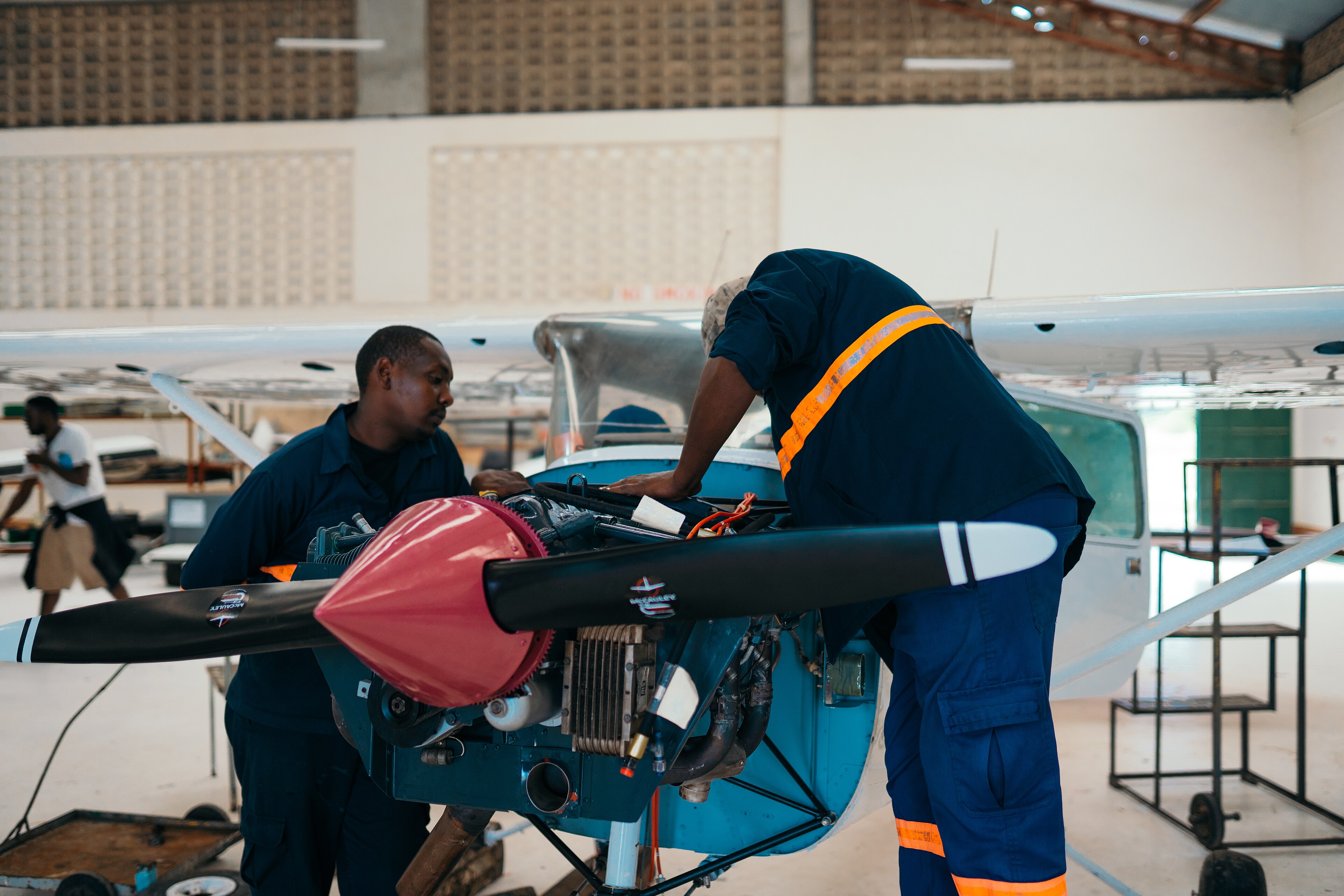
- Photo: Plane Mechanic, Isaacgnjoroge, March 1, 2019. CC BY-SA 4.0. Reduced in size.