
An ADS-B receiver shows the airplanes that are broadcasting and in range. The airplanes it misses are the ones nobody sees coming on the screen. Schochman, a small avionics maker in Slovakia, says its glass cockpit will now show a second source alongside its own receiver: SafeSky, a network that gathers traffic reported over the internet and sends it back to pilots. Schochman's post on it is dated Nov. 2. General Aviation News reported it on Nov. 5.
Schochman sells to experimental and light-sport owners. Its home page says the system fits "ultralight, LSA and experimental aircraft up to 600 kg" and is "not for certified aircraft"; its certification notes say that in the U.S. that means the experimental category and light-sport aircraft under MOSAIC.
What the screen shows
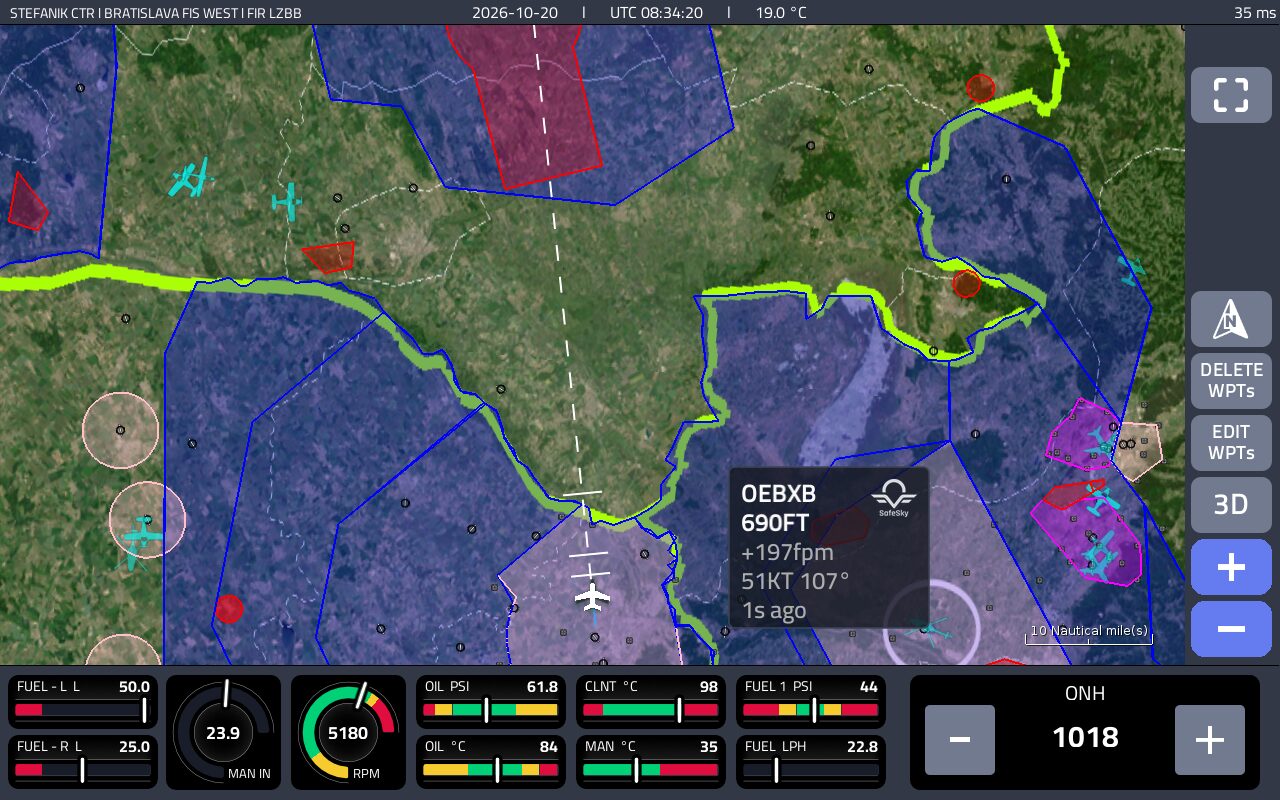
According to Schochman's post, the pilot picks the traffic source under Settings, Traffic: the onboard ADS-B receiver, SafeSky, or both. With both on, targets the receiver hears directly are drawn in green and SafeSky's in cyan. The two are merged and duplicates are removed, and "direct radio always wins on overlap." The system reads the airplane's own transponder address so it doesn't show itself as traffic.
The traffic page draws each target with an icon for its type, turned to its heading, and a dashed line for where it'll be in 60 seconds. Targets also appear in the 3D synthetic-vision view out to 50 km. The compass marks traffic amber inside about 2 nm and 2,000 feet and red when closer, and a voice calls "TRAFFIC" inside 3.5 km and 400 feet.
With SafeSky on, the airplane also sends its own position to the network about once a second, so pilots using SafeSky see it too.
What it needs, and what it costs
The onboard receiver needs no internet. SafeSky's targets do: they arrive over a data link, and the home page lists Starlink and cellular as the links the system supports. Without a link, the screen shows only what the receiver hears.
Schochman says owners won't need a SafeSky account or subscription for the first 24 months. Its price list, in euros without VAT or shipping, starts the EFIS set at €5,364 and lists "ADS-B In traffic + SafeSky" as a €662 option on the two smaller sets, included in the largest. The display is the SD-10, a 10.1-inch, 1280 by 800 touchscreen. Sets ship from Slovakia, four to eight weeks after an order.
Advisory, and only as good as the network
Schochman's own footnote says the traffic "is advisory only. It is not a certified TCAS and does not command avoidance maneuvers." SafeSky says the same of itself on its integrations page: it's meant "to supplement, not replace" ADS-B or FLARM equipment and to help pilots keep up the see-and-avoid that VFR flying depends on.
A network shows what reaches it. Schochman's post calls SafeSky "Europe's live SafeSky traffic network." Neither company says how much traffic it carries over the United States.
What isn't known
Schochman's pages don't say whether its receiver hears 1090 MHz, 978 MHz UAT or both, the two ADS-B frequencies used in the U.S. The post says the feature arrives in the fourth quarter of 2026 but gives no date. Schochman lists no U.S. dealer. SafeSky's own news and integrations pages didn't mention Schochman on Nov. 9.
For an owner laying out a panel around any 10-inch display, the Panel Designer on Hangar Flying shows it to scale in the airplane's own panel.
Sources: All read Nov. 9, 2026. Schochman, "Your Traffic Screen Isn't Telling You the Whole Story," Nov. 2, 2026, and its home, hardware and features pages; SafeSky, third-party integrations; General Aviation News, Nov. 5, 2026 (the pointer).
Picture: Schochman's screen capture from its Nov. 2 post, used with its announcement.