
Safety wire does not hold torque. The FAA's Advisory Circular 43.13-1B says so in its first paragraph on the subject: safetying is "not a means of obtaining or maintaining torque, rather a safety device to prevent the disengagement of screws, nuts, bolts, snap rings, oil caps, drain cocks, valves, and parts." Chapter 7, section 7 of the circular gives the rules that every safety-wire installation follows. The circular is not a regulation, and a manufacturer's instructions come first where they exist.
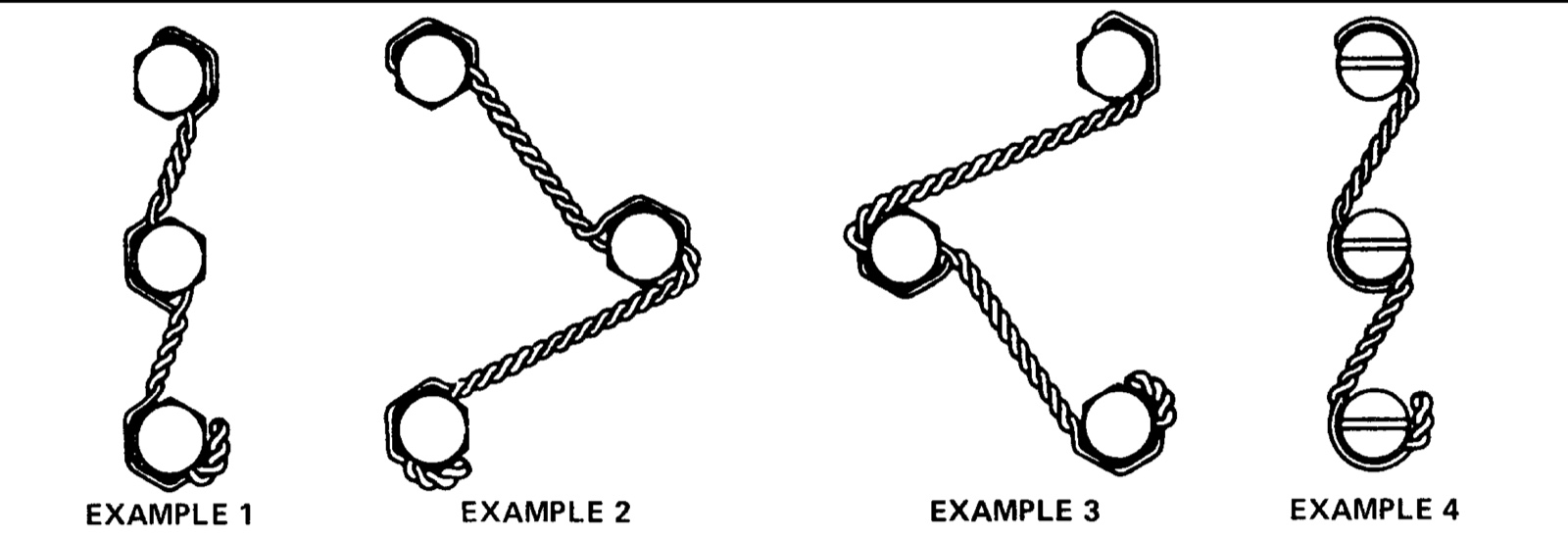
Three ways to safety a fastener
Paragraph 7-122 names three basic methods: safety wire, cotter pins and self-locking nuts. Wire, of soft brass or steel, is used on cylinder studs, control cable turnbuckles and engine accessory attaching bolts. Cotter pins are used on controls, landing gear and tailwheel assemblies, or any other point where a turning or actuating movement takes place. Self-locking nuts are for places where they will not be removed often, because repeated removal causes the nut to lose its locking feature.
Paragraph 7-124 adds that drilled bolt heads and screws need not be safety wired if they are installed with self-locking nuts.
Which wire
There are two methods. The double-twist method is the one most commonly used. The single-wire method is for screws, bolts or nuts in a closely spaced or closed pattern, such as a triangle, square, rectangle or circle, and may also be used on parts in electrical systems and in places that are difficult to reach.
For the double-twist method, paragraph 7-123 calls for wire of 0.032 inch minimum diameter on parts with a hole diameter larger than 0.045 inch. Wire of 0.020 inch diameter may be used on parts with a nominal hole diameter between 0.045 and 0.062 inch where the spacing between parts is less than 2 inches. For the single-wire method, the largest wire the hole will take should be used.
Emergency equipment is a separate case. The circular says not to use stainless steel, monel, carbon steel or aluminum alloy safety wire to secure emergency mechanisms such as switch handles, guards on exit handles, fire extinguishers or emergency gear releases. Where the equipment works by shearing or breaking the wire, the wire must not prevent that.
The rules common to every installation
Paragraph 7-124 lists them:
- Safety wire must be tight after installation, to prevent failure from rubbing or vibration.
- It must be installed in a manner that prevents the tendency of the part to loosen. The circular's figure says the wire should always be applied so that tension is in the tightening direction.
- It must never be overstressed. Wire twisted too tightly will break under vibration. It is pulled taut while being twisted and keeps a light tension when secured.
- The ends are bent under and inward toward the part, so that no sharp end projects.
- Inside a duct or tube, the wire must not cross or obstruct a flow passage when another routing can be used.
- Where practicable, the wire goes around the head of the bolt, screw or nut, with the loop fitting closely to its contour.
Before the wire goes on
The parts are torqued first. The circular says to check that the units have been correctly torqued and that the wiring holes are properly aligned to each other, and it is plain about what not to do: "Never overtorque or loosen to obtain proper alignment of the holes." A washer may be used to establish alignment. If the holes cannot be aligned within the specified torque limits, the circular says to try another bolt.
For a castellated nut, paragraph 7-126 says to tighten to the low side of the selected torque range, unless otherwise specified, and if necessary to continue tightening until a slot lines up with the hole.
Handling the wire
Safety wire must not be nicked, kinked or mutilated. When pliers are used, the wires are grasped at the ends, so the twisted section is not damaged. The ends are never twisted off with pliers. When the ends are cut, at least four to six complete turns, 1/2 to 5/8 inch long, are left after the loop.
Wire is removed by cutting it close to the hole, not by twisting it off.
The wire twister
Paragraph 7-125 describes the tool: the wire is gripped in the jaws, the sleeve locks the handles, and pulling the knob spins the spiral rod and twists the wire. It carries two cautions. When the wire extends 3 inches beyond the jaws, it should be loosely wrapped around the pliers to prevent whipping and possible injury. And excessive twisting weakens the wire.
Sources
- FAA, AC 43.13-1B with Change 1, chapter 7, section 7: paragraphs 7-122 to 7-126 and figure 7-5. Read October 11, 2026.
- Picture: figure 7-5 of the same circular, a work of the U.S. Government.