
When the primary flight display goes dark in cloud, the panel's backup is all that's left to fly by. For a builder laying out an all-glass panel, the backup isn't an afterthought: it decides what the airplane can still do when the main screens fail.
What the regulation lists
For IFR flight, 14 CFR 91.205(d), written for standard-category airplanes, lists the day-VFR instruments (airspeed, altimeter, magnetic direction indicator and the rest of paragraph (b)) plus two-way radio and navigation equipment suitable for the route, a gyroscopic rate-of-turn indicator, a slip-skid indicator, a sensitive altimeter adjustable for barometric pressure, a clock with hours, minutes and seconds, a generator or alternator of adequate capacity, a gyroscopic pitch and bank indicator, and a gyroscopic direction indicator. The rate-of-turn indicator isn't needed in an airplane with a third attitude instrument system usable through 360 degrees of pitch and roll. An experimental airplane's own operating limitations say which equipment requirements apply to it.
What builders choose
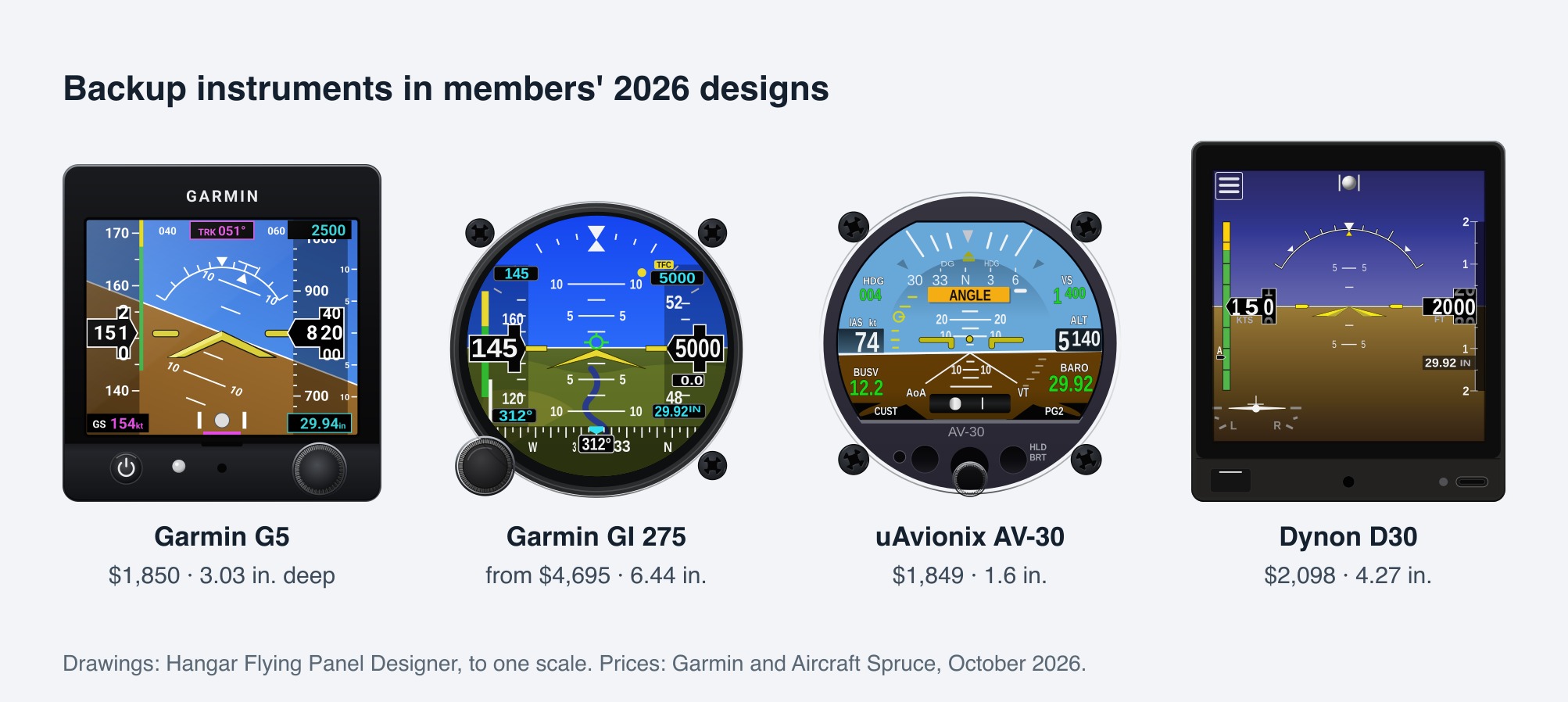
Of the 2,455 panel designs Hangar Flying members started between January 1 and October 27, 2026, these four backups lead:
- Garmin G5, in 783 designs. Garmin lists it at $1,850 for experimental aircraft. Garmin gives it as 3.03 in. deep and 0.83 lb with its battery, drawing 0.2 A average at 14 V.
- Garmin GI 275, in 407 designs. Garmin lists the attitude (ADI) version from $4,695. It fits a 3-1/8 in. hole, but Garmin gives it as 6.44 in. deep, 7.40 in. with its connector, and up to 2.4 lb depending on version.
- uAvionix AV-30, in 167 designs. Aircraft Spruce lists the AV-30-E at $1,849. uAvionix gives it as 1.6 in. deep without its connector and 0.56 lb, running about an hour on its internal battery.
- Dynon D30, in 107 designs. Aircraft Spruce lists it at $2,098. Dynon gives it as 4.27 in. deep and 1.1 lb with its battery.
Dynon's D3, a pocket display, lists at $998 at Aircraft Spruce and is only 1.16 in. deep.
What to check before choosing
Three questions settle most choices. Does the backup have its own battery, and for how long does the manufacturer say it runs? Does it have its own air data and attitude sensing, so that it doesn't share a failure with the primary display? And what does it show when everything else has failed: attitude alone, or airspeed, altitude and heading too? The installation manual answers all three. The panel then needs a place where the pilot's eyes go naturally when the main screens go dark.
Sources
- 14 CFR 91.205(b) and (d), Powered civil aircraft with standard category U.S. airworthiness certificates: Instrument and equipment requirements. Read October 27, 2026.
- Hangar Flying, Panel Designer: count of members' panel designs started January 1 to October 27, 2026 (administrator and test accounts left out; no member named).
- Garmin, G5 Installation Manual 190-01112-10 Rev. 32, Tables 1-3 and 1-4; GI 275 Maintenance Manual 190-02246-11 Rev. 11, Table 2-2; GI 275 product page. Garmin list prices as read for Hangar Flying's Panel Designer, October 16 and 27, 2026.
- uAvionix, AV-30-E Installation Manual, Rev G, Table 6-1; Aircraft Spruce, AV-30. Read October 27, 2026.
- Dynon, D30 Installation and Maintenance Manual 103997-000 Rev B and D3 Pilot's Guide 103538-000 Rev A, docs.dynonavionics.com; Aircraft Spruce, Dynon SkyView and D30, D3. Read October 27, 2026.