
A builder laying out the breaker row often starts from the wrong number. The display's manual says it draws a little over 2 amps, the transponder less than half an amp, and it seems to follow that each should get a breaker just above its own draw. The makers' recommendations don't work that way, and Dynon's installation guide says why in one sentence.
"It is important that circuit protection devices be appropriately sized to protect the wiring connected to them," reads page 2-5 of the SkyView HDX installation guide (Revision AX, July 2026). The emphasis is Dynon's. A breaker or fuse is there to open before the wire overheats. The box at the far end looks after itself.
Hangar Flying's wire size calculator is at hangarflying.com/wire-size. It takes the bus voltage, the lowest voltage the load accepts, the current, the one-way length of the run, and whether the wire runs in free air or in a bundle or a hot area, and it names the smallest copper wire for that circuit. With the wire known, the breaker or fuse is the one that protects it.
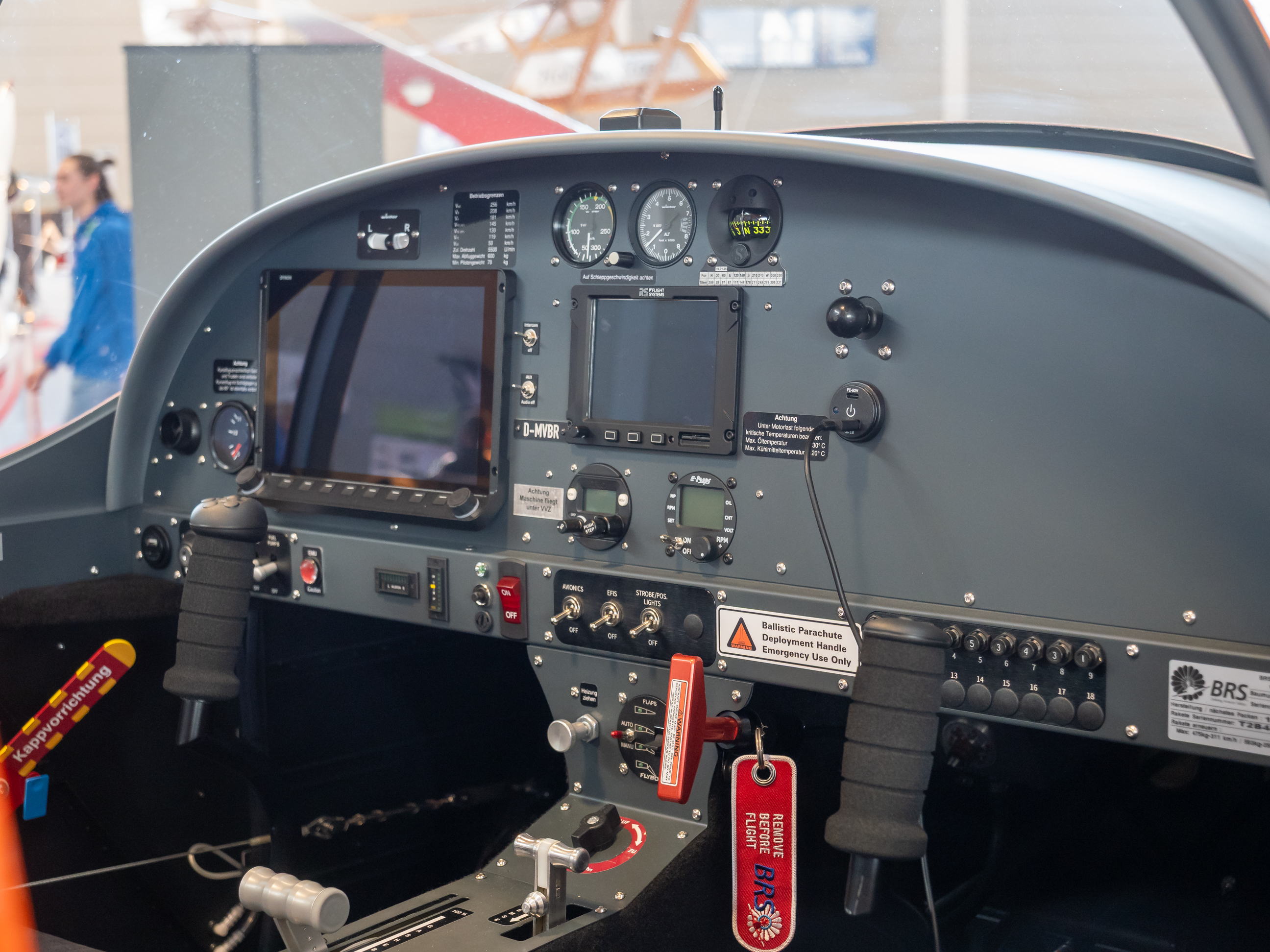
Why almost everything gets 5 amps
Dynon's two power tables (pages 2-4 and 2-5) recommend 5-amp protection for nearly every unit in the system. The guide gives two reasons: 5 amps "is the smallest circuit breaker that is commonly available in certified versions, and Dynon wiring harnesses specify wire of at least 22 AWG." A 5-amp device protects that wire, so it serves whether the unit behind it draws 0.1 amp or 3.
The guide leaves room for other sizes: "It may be possible to use different sized circuit protection if the protective device has suitable load overhead for the device(s) connected to it." A builder who runs heavier or lighter wire than Dynon's harness works it out again from the wire. Hangar Debrief's piece on wire sizing covers the FAA's table that matches a breaker or fuse to each wire gauge, and the wire size calculator gives the smallest wire for a current and a length of run.
Circuit by circuit
From Dynon's tables, at 12 volts:
- Each display: 5 A. An SV-HDX800 draws 2.10 A, an SV-HDX1100 2.40 A and an SV-HDX1200 2.20 A at full brightness, before anything the display powers.
- SV-ADSB-472 receiver: 5 A (draws 0.1 A).
- SV-COM-760 radio: 5 A (0.35 A receiving, 3.00 A transmitting).
- SV-XPNDR-261/262/263 transponder: 5 A (0.40 A).
- Autopilot servos: 5 A. At full torque an SV32 draws 1.30 A, an SV42 2.00 A and an SV52 2.80 A; a servo that is not engaged draws 0.13 A.
- SV-AP-PANEL trim control and SV-AP-TRIMAMP: 5 A each. The trim motor decides the current; the trim amplifier's maximum is 5.00 A.
- SV-AUDIO-6BTR audio panel: the table reads "3.5 Amp (Externally protected by a 5A pull-type breaker)." The panel draws up to 1.60 A with a device charging from its USB port, 0.65 A without.
- Heated AOA/pitot probe: 10 A. It draws 10.00 A at maximum heat and is a 12-volt part only.
- SV-INTERCOM-2S and the serial-to-gray-code converter: 5 A, "or add to another circuit." Each draws a tenth of an amp or less.
Count those up for a one-display panel with a radio, transponder, ADS-B, autopilot, trim, audio panel and heated pitot, and it's eight circuits before the airframe's own: lights, fuel pump, flaps, the alternator field.
What rides on the display's breaker
Several units have no power wire of their own. The backup battery and the GPS receiver plug into a display and draw through it; the ADAHRS, the engine monitor module, the autopilot panel, the knob panel and the ARINC-429 module take their power from the SkyView Network, which the displays feed. With two displays each carries half of the network's load, and with three, a third.
Dynon works one example: an SV-D1000T display (2.40 A) with an SV-BAT-320 backup battery charging (1.00 A), an SV-GPS-2020 (0.10 A), an SV-ADAHRS-200 (0.15 A) and an SV-EMS-220 (0.11 A) "will require 3.76A when charging the battery, 2.76A when the battery is fully charged." That's still inside the display's 5 amps, with a margin.
Each display's harness has two red power wires. The guide says they are there "to reduce current loading in each wire," are "not for redundancy," and both go to the same power source.
Breaker or fuse
Dynon accepts either. Page 4-12 asks for "an appropriately rated circuit breaker or replaceable fuse on the primary power input." The one place the tables name a type is the audio panel's pull-type breaker, which a pilot can open by hand.
The difference shows up in the parts bill. At Stein Air, a Klixon 7277 pull-type breaker in 5 or 10 amps is $29.50, and a Potter & Brumfield W23 pull-type is $55 in 4 amps. A 5-amp W31 breaker switch, which is a toggle switch and a breaker in one, is $59. A blade fuse block is $23.50 for six circuits and $34.50 for ten, plus the fuses. Eight Klixons come to $236; one ten-circuit block covers the same circuits for $34.50.
A fuse that opens is replaced, not reset, so a fuse block has to be somewhere it can be reached, and the right spares have to be aboard. A pull-type breaker can also be opened on purpose, which is how a pilot shuts off one misbehaving box without the master switch. Many builders mix the two: pull-type breakers on the panel for the few circuits a pilot may want to open in flight, and a fuse block for the rest.
Whichever it is, the rating follows the wire, and the installation manual for each box has the last word on that box. Garmin, Advanced Flight Systems and the radio makers publish their own tables; the figures above are Dynon's and apply to Dynon's units and harnesses.
The wire size calculator is at hangarflying.com/wire-size.
Sources
- Dynon Avionics, SkyView System Installation Guide, Revision AX (July 2026): "Power Specifications," Tables 3 and 4, pages 2-4 and 2-5; "Power Input," page 4-12. Read Nov. 12, 2026.
- Stein Air, Klixon Circuit Breaker, 5 Amp and 10 Amp (7277-5, 7277-10), Circuit Breaker, 4 Amp (W23-4), Circuit Breaker Switch, 5 Amp (W31M-5), Fuse Block, 6 Circuit (SA-301) and Fuse Block, 10 Circuit (SA-303). Prices as listed Nov. 12, 2026.
- Photo: Breezer, AERO 2025, Friedrichshafen (P1046986).jpg), Matti Blume, April 12, 2025. CC BY-SA 4.0. Used as uploaded.