
Most of the boxes behind a glass panel plug in through D-sub connectors, the D-shaped shells with 9, 15, 25, 37 or more positions. A builder who wires a panel, or adds one radio to it, ends up putting a small machined pin or socket on the end of each wire and pushing it into the back of a shell. Each of those contacts is one crimp.
Garmin's G3X Touch installation manual (Revision BA, October 2026) leaves the method in no doubt. Section 2.3 says: "Contacts for the connectors must be crimped onto the individual wires of the aircraft wiring harness." Dynon's SkyView HDX installation guide (Revision AX, July 2026) supplies finished harnesses and says installers "should rarely have to build custom wire harnesses," but its Appendix C gives the contacts and the tool for the times one is built.
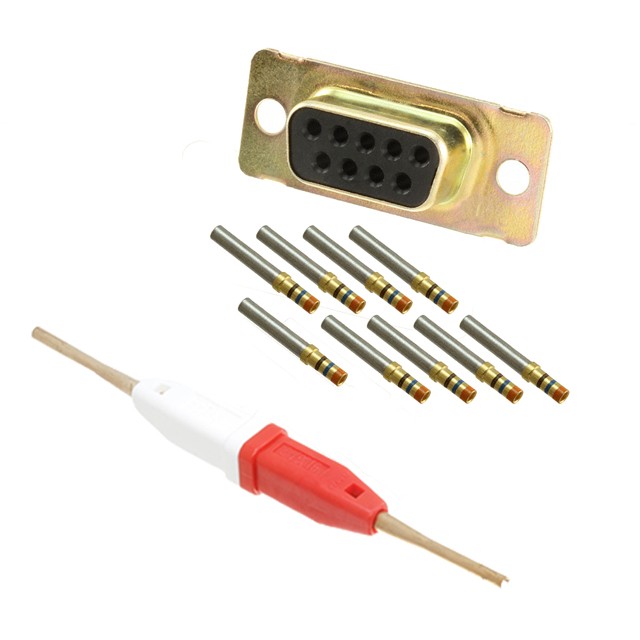
Two sizes of contact
The contacts come in two sizes, and the size decides the tooling.
Size 20 is the contact of a standard D-sub, such as a 9-, 15-, 25- or 37-position shell. Dynon's guide recommends two military-specification types for avionics work (Table 119, page 26-2): M39029/63-368 for the socket and M39029/64-369 for the pin, for 20, 22 and 24 AWG wire. Garmin's Table 1-8 lists the same two specifications beside its own part numbers for some of its units.
Size 22D is the thinner contact of a high-density D-sub, which fits more positions into the same shell. Garmin's table lists a size 22D pin, M39029/58-360, for the GMC 507 autopilot controller, the GTP 59 temperature probe and several other units.
The two do not interchange. A harness for a mixed panel usually needs both, and the manual for each box says which.
The tool, and the part that fits it to the contact
Dynon asks for "a high quality 4-way indentation contact crimper" and gives Paladin Tools' part number 1440, for 20 to 26 AWG wire, as an example. A four-way indent crimper presses four small dents into the barrel of the contact at once, from four sides, so the barrel closes evenly around the strands.
Garmin's table names the tool by its military specification, M22520/2-01, for every contact in it. What changes with the contact is the positioner, the small fitting that goes into the tool and holds the contact at the right depth:
- Size 20 pins and sockets: positioner M22520/2-08 (Daniels K13-1).
- Size 22D pins: positioner M22520/2-09 (Daniels K42, or Positronic 9502-4).
The table also names the tools that push a contact into the shell and pull it back out: M81969/1-02 for size 20 and M81969/1-04 for size 22D. Garmin adds that "other equivalent tooling may also be used," and that the part numbers that are not Garmin's are not maintained by Garmin and may change.
One row of the table shows how fine the adjustment gets. For a size 20 socket made for 26 to 30 AWG wire, Garmin says to use crimp setting 6 for 28 AWG wire. A tool with a selector is set for the wire gauge, not left where the last job had it.
What it costs
Stein Air, a common source for homebuilders, lists both kinds of tool. Its four-way indent crimper (SAT-004) is $38; the page says it is for standard D-sub contacts on 20 to 22 AWG wire only, and that high-density pins need a separate insert. The Daniels AFM8, which Stein Air lists as the M22520/2-01, is $725. Stein Air's own advice on that page is that the less expensive crimper is fine for a couple of pins.
The contacts are sold in packs of 25: standard pins (M39029/64-369) for $22.50, standard sockets (M39029/63-368) for $23.75, and high-density pins (M39029/58-360) for $15. Stein Air rates the standard contacts at 7.5 amps.
Making the crimp
Garmin's manual gives the steps in its connector assembly instructions (Section 23, page 23-7):
- Strip about 0.17 inch of insulation from the wire. The manual marks that figure as a reference and says "it is the responsibility of the installer to find the proper length of insulation to be removed."
- Crimp the contact onto the conductor.
- Look at the inspection hole in the side of the barrel. In the manual's words, "wire must be visible in the inspection hole after crimping."
- Look at the gap between the insulation and the end of the contact. It must be 1/64 to 1/32 inch.
The inspection hole is the check a builder can make on every contact without a second tool. If no strands show in the hole, the wire did not reach the bottom of the barrel, and the crimp does not meet the manual.
The wire, and the back of the shell
Both makers name the wire. Garmin calls for MIL-W-22759/16 or other approved wire, 22 AWG or larger unless a drawing says otherwise, and MIL-C-27500 for shielded cable. Dynon recommends Tefzel insulation and 22 AWG for harness wires unless otherwise specified, and asks that the data pairs of a SkyView Network cable be twisted 8 to 10 twists per foot over the whole length. Dynon notes that 22 AWG is normally enough for a unit's power and ground lines but tells the installer to check a wire sizing chart for the run; Hangar Flying's wire size calculator (hangarflying.com/wire-size) works out the smallest wire for a given current and length.
Dynon's guide also says what happens behind the connector: the wires are "bundled together with heat shrink and then strain relieved when exiting the connector shell or hood." A crimp is a mechanical joint, and a bundle that is free to move works every contact at the point where it leaves the barrel.
Two warnings in Dynon's appendix apply to any maker's harness. Improper wiring can permanently damage the instrument and its sensors, and all connections are made before the harness is plugged in, never with power on anywhere in the system. Garmin's caution is the same in other words: check the wiring for errors before connecting a harness.
The manual for each box remains the authority for that box, including which contact its connector takes. For terminals larger than these, Hangar Debrief's piece on crimped terminals covers the tool and the joint.
Sources
- Garmin, G3X/G3X Touch Avionics Installation Manual, 190-01115-01, Revision BA (October 2026): Section 1.5.2 and Table 1-8, "Pin Contact and Crimp Tools Part Numbers," page 1-8; Section 2.3, "Wiring/Cabling Considerations," page 2-20; Section 23, step 5 and Figure 23-3, page 23-7. Read Nov. 17, 2026.
- Dynon Avionics, SkyView System Installation Guide, Revision AX (July 2026): Appendix C, "Wiring and Electrical Connections," pages 26-1 to 26-3, including Table 119. Read Nov. 17, 2026.
- Stein Air, Crimper, 4 way indent, Daniels Mil Spec Crimper, AFM8, Standard Dsub Pin, Standard Dsub Socket and High Density Dsub Pin. Prices as listed Nov. 17, 2026.
- Photo: Hangar Debrief.