
An owner adding a second display, a navigator and an autopilot to a panel is also adding load to an alternator that may have been chosen for a much simpler airplane. For IFR flight, 14 CFR 91.205(d), written for standard-category airplanes, asks for a "generator or alternator of adequate capacity" without saying what adequate means; an experimental airplane's own operating limitations say what applies to it. The starting point is the current each box draws, and that figure is in its installation manual.
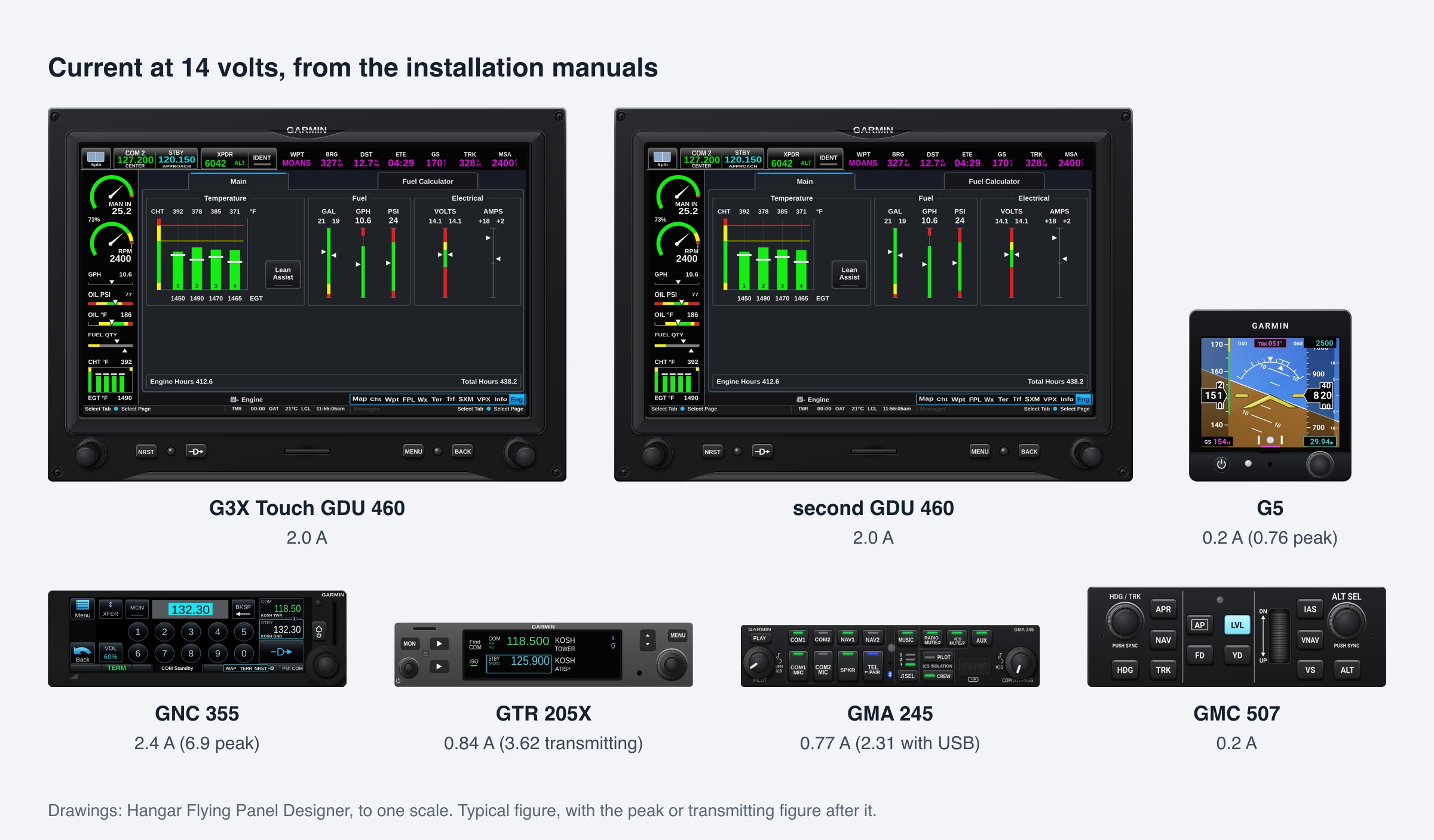
What the boxes draw at 14 volts
From the manufacturers' published tables:
- Garmin G3X Touch GDU 460 10.6-inch display: 2.0 A (backlight at full).
- Dynon SkyView HDX 10-inch: 2.4 A at 12 V, at full brightness. Dynon recommends 5 A circuit protection.
- Advanced Flight Systems AF-5600: 2.8 A at 12 V.
- Garmin G5: 0.2 A average, 0.76 A peak.
- Garmin GI 275: 0.65 A, 0.75 A peak without its battery; 1.70 A peak with the battery charging.
- Dynon D30: 0.6 A at 12 V, 1.1 A while its battery charges.
- Garmin GNC 355 navigator and com: 2.4 A typical, 6.9 A peak.
- Garmin GPS 175 navigator: 0.6 A, 0.9 A peak.
- Garmin GMA 245 audio panel: 0.77 A, 1.11 A peak without USB charging, 2.31 A with a device charging from its port.
- Garmin GTR 205 com radio: 0.84 A receiving, 3.62 A transmitting at 10 watts (4.98 A at 16 watts).
- Garmin GMC 507 autopilot mode controller: 0.2 A. The autopilot's servos are a separate load.
Garmin doesn't publish a current for the GTN 650Xi in its brochure. For a GTN, the figure comes from its installation manual.
Adding it up
Take a panel of two GDU 460 displays, a G5, a GNC 355, a GTR 205, a GMA 245 and a GMC 507. Steady cruise, receiving, with no USB charging: 2.0 + 2.0 + 0.2 + 2.4 + 0.84 + 0.77 + 0.2 comes to about 8.4 A. Keying the second radio adds roughly 2.8 A while it transmits, and the navigator's own com can peak higher. That's before the airframe's own loads: position and strobe lights, landing lights, pitot heat, the fuel pump, the transponder, ADS-B, and the sensors behind the panel.
Why the alternator matters
The figure that matters is the total in the worst normal case (night, in cloud, pitot heat on, transmitting), set against the alternator's rated output and what the battery and any backup batteries can carry if the alternator fails. Several backup instruments now carry their own batteries: the G5, the GI 275 and the D30 all list a battery and its charging current. The draw on that list is the draw the panel puts on the system when the alternator quits.
An electrical load analysis is the builder's own worksheet. The manuals give the inputs, but no catalog gives the answer.
Sources
- 14 CFR 91.205(d)(7), Powered civil aircraft with standard category U.S. airworthiness certificates: Instrument and equipment requirements. Read October 27, 2026.
- Garmin, G3X/G3X Touch Avionics Installation Manual 190-01115-01 Rev. AZ, Table 2-2 (GDU 460, GMC 507).
- Garmin, G5 Installation Manual 190-01112-10 Rev. 32, Table 1-4; GI 275 Maintenance Manual 190-02246-11 Rev. 11, Table 2-2; GMA 245/245R Installation Manual 190-01879-11 Rev. 14, Table 1-6; GTR 205/GNC 215 TSO Installation Manual 190-02766-01 Rev. 6, Table 1-9; General Aviation Solutions brochure (GPS 175); Experimental/LSA brochure (GNC 355).
- Dynon, SkyView HDX System Installation Manual Rev P, Table 4; D30 Installation and Maintenance Manual 103997-000 Rev B, 2.1.
- Advanced Flight Systems, AF-5000 Series Install Manual V15.1, Physical and Power Requirements.
- All figures as recorded in Hangar Flying's Panel Designer library from the documents above, read October 18 to 27, 2026.