
The Wire Size Calculator names the smallest copper wire for an aircraft DC circuit. The wire has to pass two checks: the voltage lost along it must be within what the load can stand, and the current must be within what the wire carries for the temperature rise you choose. It is open to everybody, signed in or not.
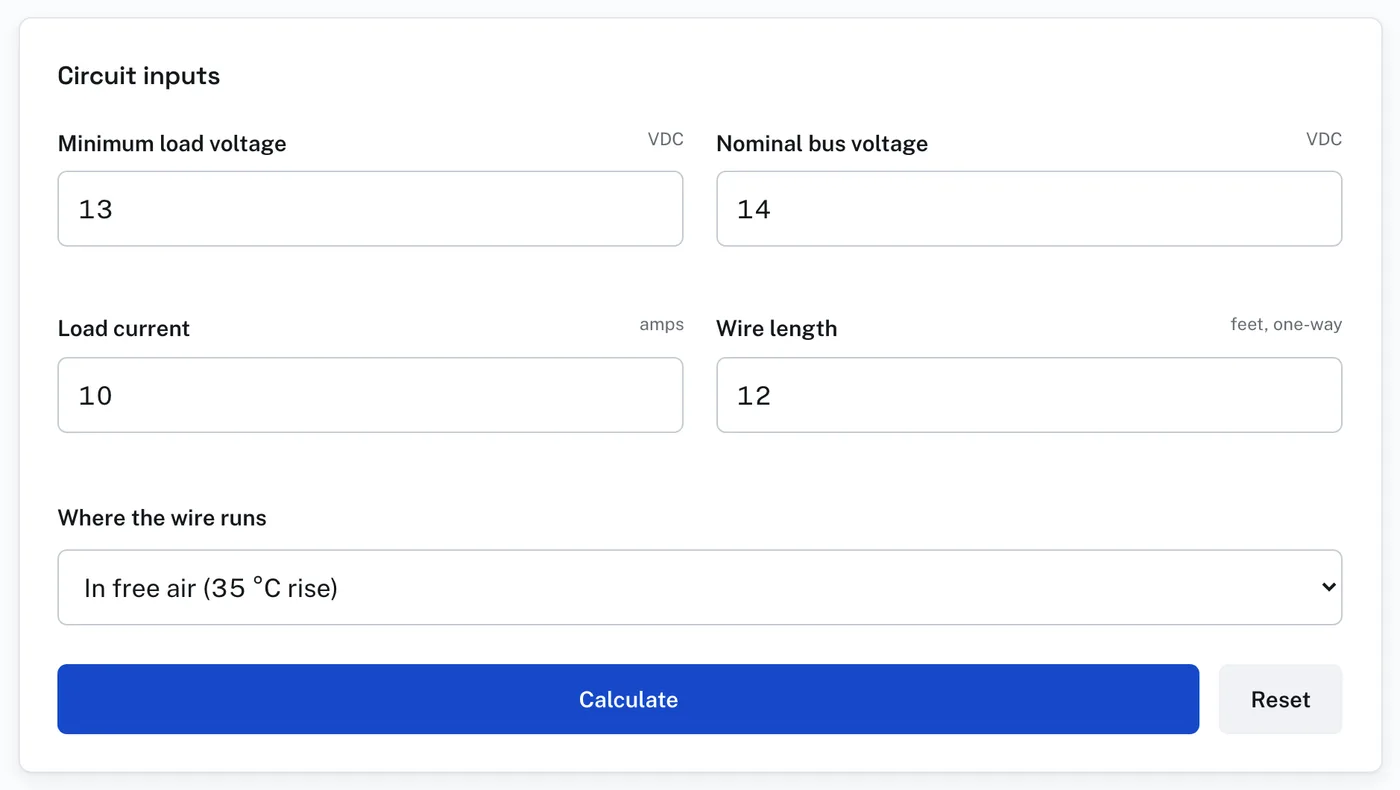
To size a wire:
- Press Tools in the bar at the top of any page, or Wire size calculator at the foot.
- Minimum load voltage: the lowest voltage the equipment will work at, in volts DC.
- Nominal bus voltage: the voltage of the aircraft’s electrical system, for example 14 or 28.
- Load current: what the equipment draws, in amps.
- Wire length: the length of the run from the bus to the equipment, in feet, one way. The calculator doubles it for the return wire.
- Where the wire runs: choose "In free air (35 °C rise)" for a single wire in open air, or "In a bundle or a hot area (10 °C rise)" for a wire in a bundle or a hot part of the aircraft. The second choice holds the wire to a lower current, so it can call for a larger wire.
- Press Calculate. Reset empties the form.
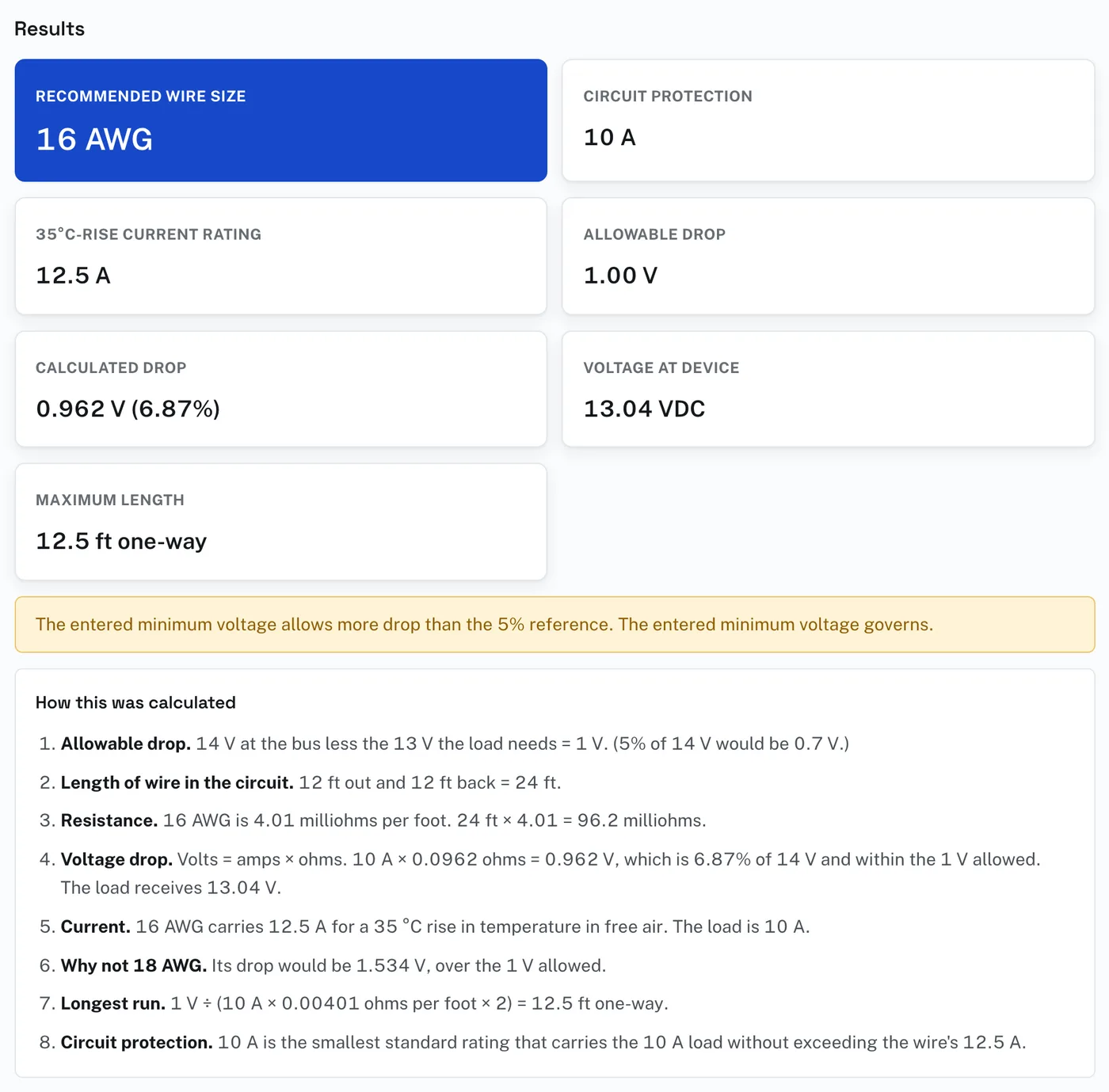
What Results shows:
- Recommended wire size: the smallest AWG size that passes both checks. A smaller AWG number is a larger wire.
- Circuit protection: the smallest standard breaker or fuse rating that carries the load without exceeding what the wire carries.
- Current rating: what that wire carries for the temperature rise you chose.
- Allowable drop: the volts the circuit may lose. It is the bus voltage less the minimum load voltage.
- Calculated drop: the volts this wire loses, and that as a percentage of the bus voltage.
- Voltage at device: what reaches the equipment.
- Maximum length: the longest one-way run this wire allows at this current.
A line under the figures says which limit set the allowable drop. If you enter the same voltage for the minimum and the bus, the calculator allows 5% of the bus voltage. If your minimum allows more than 5%, your minimum governs, and the line says so.
How this was calculated works the answer through with your own numbers, a step at a time: the allowable drop, the length of wire in the circuit, its resistance, the voltage drop, the current, why the next smaller wire was not chosen, the longest run, and the circuit protection.
Under that, Wire is the table the figures come from: each size from 22 AWG to 2 AWG with its milliohms per foot and the amps it carries for a 35 °C and a 10 °C rise. The row of your answer is marked. The figures are for copper aircraft wire to MIL-W-22759/16.
If no size in the table passes both checks, Results says "No listed AWG satisfies both limits." Shorten the run, reduce the current, or allow more drop.
The numbers you entered are in the page’s address after you press Calculate. Copy the address to send the calculation to somebody else, or bookmark it to come back to it.
Design aid only. Verify insulation, bundling, ambient temperature, terminal ratings and fault current before installation.